Summer in Ogden is pretty much undefeated, especially if you have a pool in the backyard to beat that dry Utah heat. But there is nothing—and I mean nothing—that kills the vibe faster than staring at a giant, jagged crack running right through your Pool Deck or realizing one side of the concrete has sunk two inches lower than the other. It’s ugly, sure, but it’s also a massive toe-stubbing nightmare waiting to happen.
So, Why Is Your Concrete Acting Weird?
You know what? Concrete feels permanent. When we pour it, we assume it’s going to sit there, rock-solid, until the end of time. But here’s the thing about living along the Wasatch Front: the ground beneath our feet is constantly moving, even if we don’t feel it.
Your pool deck isn’t floating in space; it’s sitting on soil. And that soil is subject to a lot of drama. We’re talking about soil erosion, compaction, and the dreaded freeze-thaw cycle that defines our winters. When the soil underneath your concrete slab shrinks or washes away, it leaves behind what we in the industry call a “void.”
Think of it like a rug on a hardwood floor. If you put a heavy box on a rug that has a hollow spot underneath it, the rug is going to dip. Concrete works the same way. It’s rigid, but it’s heavy. If the support is gone, gravity takes over, and the slab sinks.
Honestly, it’s not usually the concrete’s fault. It’s the dirt.
The Trip Hazard Nobody Talks About
Let’s be real for a second. The aesthetic part is annoying, but the safety issue is what usually gets homeowners to pick up the phone. A sunken concrete slab creates a lip. On a Driveway, that’s a nuisance. On a pool deck? That’s dangerous.
You have kids running around, wet feet, maybe a little too much excitement near the deep end. If you catch a toe on a raised edge of concrete, it’s game over. It’s a harsh reality, but uneven concrete is a leading cause of trips and falls at home.
Plus, there’s the issue of the pool itself. If your deck sinks, it might damage the coping—that’s the cap on the edge of the pool shell. If the deck puts pressure on that bond beam or the coping stones, you’re looking at a much more expensive repair than just fixing a Sidewalk. You want to fix the deck before it starts breaking the pool.
Don’t Replace It, Lift It
I talk to people all the time who think their only solution is to rip everything out and start over. They imagine jackhammers, dust clouds, heavy machinery tearing up the lawn, and a bill that looks like a down payment on a new car.
Here’s the good news: Concrete Lifting—often called Mud Jacking or slab jacking—is a fraction of the cost of replacement.
When you replace concrete, you are paying for:
- Demolition labor
- Debris removal and disposal fees
- New base material
- New concrete
- Finishing labor
When you lift concrete, you are paying for a surgical repair. We use the existing slab, which is usually still structurally sound, and we just give it a lift back to its original position. It’s recycling at its finest.
The Breakdown: Replacement vs. Lifting
| Feature | Concrete Replacement | Concrete Lifting |
|---|---|---|
| Cost | High ( $$$$ ) | Affordable ( $$ ) |
| Time to Fix | Days or Weeks | Hours |
| Useability | Wait 7-28 days to cure | Walk on it immediately |
| Mess Factor | heavy dust, lawn damage | Minimal, tidy |
| Color Match | New concrete stands out | Keeps original look |
How Does Mud Jacking Actually Work?
It sounds like magic, but it’s actually just physics and hydraulics.
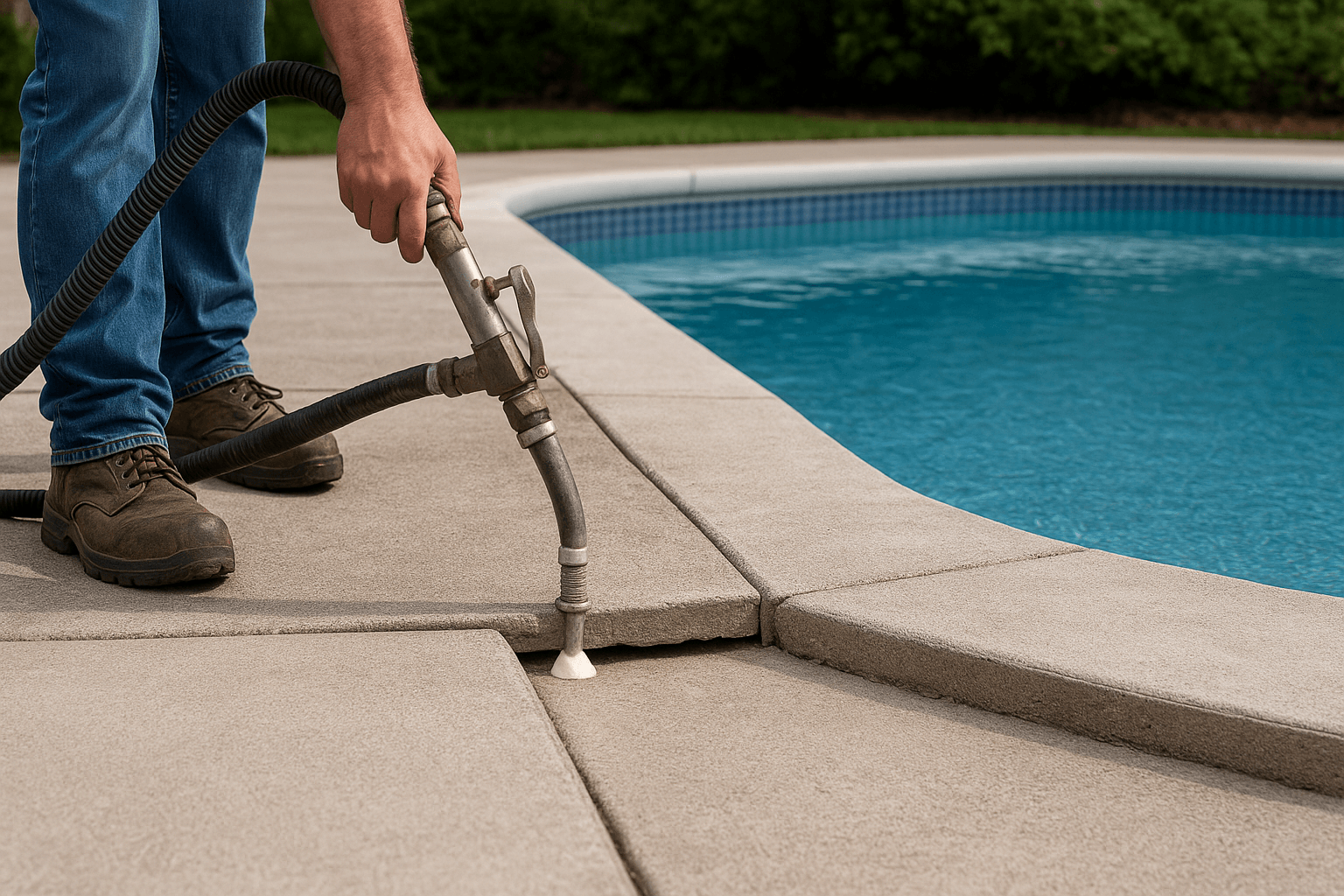
The process is surprisingly straightforward. We drill small holes—about the size of a quarter—strategically placed through the sunken slab. Then, we pump a specialized mixture underneath the concrete. In the old days, and still for many Applications, this was a mud-cement slurry (hence the name mud jacking).
This mixture flows into those voids I mentioned earlier. It fills up the empty space where the dirt used to be. Once the void is full, the mixture becomes pressurized. Since it has nowhere else to go, it pushes up.
It creates enough hydraulic pressure to literally lift the heavy slab of concrete back to being level with the surrounding deck. Once it’s level, we patch the small holes, and you’re good to go.
It’s satisfying to watch, honestly. Seeing a two-ton slab of concrete rise up like a feather is something that never gets old.
Water Drainage: The Silent Killer of Pool Decks
Here is something homeowners often miss. When your pool deck was poured, the contractor likely pitched it slightly away from the pool. This is so rain and splash-out water run into the grass or a drain, rather than back into your clean pool water.
When a slab sinks, that slope often reverses. Suddenly, you have dirty rainwater, laden with fertilizer, dog hair, and whatever else is on your Patio, running straight into your pool.
Not only does this mess up your water chemistry (costing you more in chemicals), but it also directs water under the slab.
Remember how I said water causes erosion? If water is pooling against the foundation of the deck or running down through the crack, it’s washing away more soil. It’s a vicious cycle. The more it sinks, the more water it collects, and the faster it sinks.
By using effective concrete lifting, you restore the proper grade. You get the water flowing away from the pool and the home foundation again. It’s proactive maintenance that saves you a headache later.
The “Utah Factor”
Living in Ogden, we have specific challenges. We have hot summers and cold, snowy winters.
When water gets under a sunken slab and then freezes in January, it expands. Ice is incredibly powerful. It can heave the concrete upward, making the unevenness worse, or crack the slab further. This is frost heave.
By filling the voids under the deck with a stable material, we reduce the amount of room available for water to pool and freeze. It stabilizes the temperature dynamics under the slab to a degree. You aren’t just fixing the look; you are winterizing your hardscaping.
What About the “New” Stuff? (Polyurethane)
You might have heard about foam lifting, or polyurethane injection. It’s a similar concept to traditional mud jacking but uses a high-density expanding foam instead of a cement slurry.
Both methods have their place. The foam is lightweight, which is great if the soil is super soft and you don’t want to add more weight. It also cures very fast. However, traditional slurry is rock solid and has a compressive strength that feels very reassuring.
The goal is the same: stabilize the sub-base and lift the concrete. When you talk to a pro, they can assess the specific soil conditions in your yard. Sometimes the soil in Ogden is sandy; sometimes it’s heavy clay. The material used might depend on what’s going on down deep.
Signs You Need to Call a Pro
How do you know it’s time? I mean, a hairline crack is annoying, but is it an emergency?
Here are the red flags that suggest you shouldn’t wait:
- Tripping Hazards: If the height difference between two slabs is more than a quarter-inch, people are going to trip.
- Hollow Sounds: If you tap on the concrete and it sounds like a drum, you have a void.
- Water Pooling: If puddles form on the deck and stay there for days.
- Caulk Separation: If the caulking between the pool coping and the deck has ripped open, the deck is moving.
If you ignore these, the slab might eventually crack into smaller pieces. Once concrete is shattered like a jigsaw puzzle, lifting becomes much harder, sometimes impossible. At that point, you do have to pay for replacement. Catching it while it’s just a sunken slab is the sweet spot for saving money.
Will It Just Sink Again?
This is the most common question I get. “If I lift it, won’t gravity just win again?”
Here is the truth: If the underlying cause of the settling isn’t fixed—like a broken sprinkler pipe washing away dirt every morning—then yes, it might sink again.
But generally speaking? No.
The material we pump under the slab compacts the soil and creates a new, solid base. In many ways, the ground is more stable after lifting than it was before, because we’ve filled the voids and compressed the loose soil.
That said, you have to do your part. Make sure your downspouts are pointing away from the deck. Check your pool plumbing for leaks. Manage the drainage in your yard. If you keep the water away, the lift can last for the life of the concrete.
It’s About Curb Appeal, Too
Let’s not pretend we don’t care what the neighbors think. We do.
A level, clean concrete deck looks maintained. It looks expensive. A cracked, sinking deck looks neglected. If you are ever planning to sell your home in Ogden, the pool inspector is going to flag a sunken deck immediately. It’s a bargaining chip for the buyer to lower the price.
Fixing it now allows you to enjoy it, rather than fixing it frantically three weeks before closing on a house sale.
Plus, you can seal the cracks after lifting. Once the slab is level, you can use a high-quality concrete caulk to seal the crack and the expansion joints. It makes the whole area look seamless and keeps that pesky water out.
What to Expect on Service Day
If you decide to go ahead with concrete lifting, it’s shockingly low-stress.
You don’t need to move out. You don’t need to drain the pool. Usually, you just need to move the patio furniture and the BBQ grill off the area we’re working on.
The crew shows up, usually with a truck and a pump. They drag a hose to the backyard. It’s a bit noisy—drilling concrete isn’t exactly a whisper—but it’s quick. Most residential pool deck jobs are done in half a day.
By the time the crew cleans up (washing away the dust from drilling), you can usually walk on the concrete immediately. If it’s traditional mud jacking, we might ask you to keep heavy stuff off it for a day or so, but generally, your pool is open for business that same afternoon.
Let’s Get That Pool Ready
Summer is too short to worry about your guests tripping or your pool coping cracking. You want to fire up the grill, jump in the water, and relax.
If your concrete is looking a little tired or uneven, don’t assume the worst. You probably don’t need a demolition crew; you just need a lift. It’s faster, cleaner, and keeps more money in your pocket for the fun stuff—like pool floats and burgers.
At Mud Dog Jacking, we know Ogden soil, and we know how to fix it. If you’re seeing cracks or sinking slabs, give us a shout.