There is nothing quite as frustrating as pulling into your Driveway after a long day and feeling that jarring thump because one of your concrete slabs has decided to sink a few inches lower than the rest. It’s unsightly, it’s a trip hazard for the kids (and the delivery guy), and honestly, it just drags down the look of your entire home. But if you’re staring at that uneven concrete and stressing about the cost of ripping it all out and starting over, you can breathe a sigh of relief because there is a much smarter way to handle it.
Why is My Driveway Sinking in the First Place?
Before we get to the fix, it helps to understand what’s actually happening underneath your feet. Concrete is heavy—really heavy—but it’s only as stable as the soil supporting it. Here in Ogden, we deal with some pretty unique soil conditions and weather patterns that love to mess with that stability.
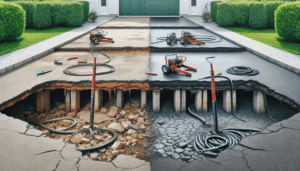
Usually, sinking happens because of soil erosion or compaction. You know how the ground gets spongy when the snow melts off the Wasatch Front? Well, water finds its way under your driveway slabs and slowly washes away the dirt. Over time, this creates pockets of empty space, or “voids.” Once that void gets big enough, the concrete has zero support, and gravity takes over. Snap. Down it goes.
Sometimes it’s not even water; it’s just poorly compacted fill dirt from when the house was built. If the construction crew didn’t pack the ground down tight enough twenty years ago, nature is doing it for them now. The result is the same: uneven, sunken concrete that looks like a skateboard ramp gone wrong.
Enter the Hero: What is Mud Jacking?
You might hear this process called a few different things—slab jacking, Concrete Lifting, or pressure grouting—but around here, we stick with the classic term: mud jacking.
Don’t let the name fool you, though. We aren’t pumping backyard dirt under your pristine driveway. The “mud” is actually a sophisticated slurry mixture. It’s typically a blend of water, soil, sand, and cement (usually Portland cement). Think of it like a really thick milkshake that dries as hard as rock.
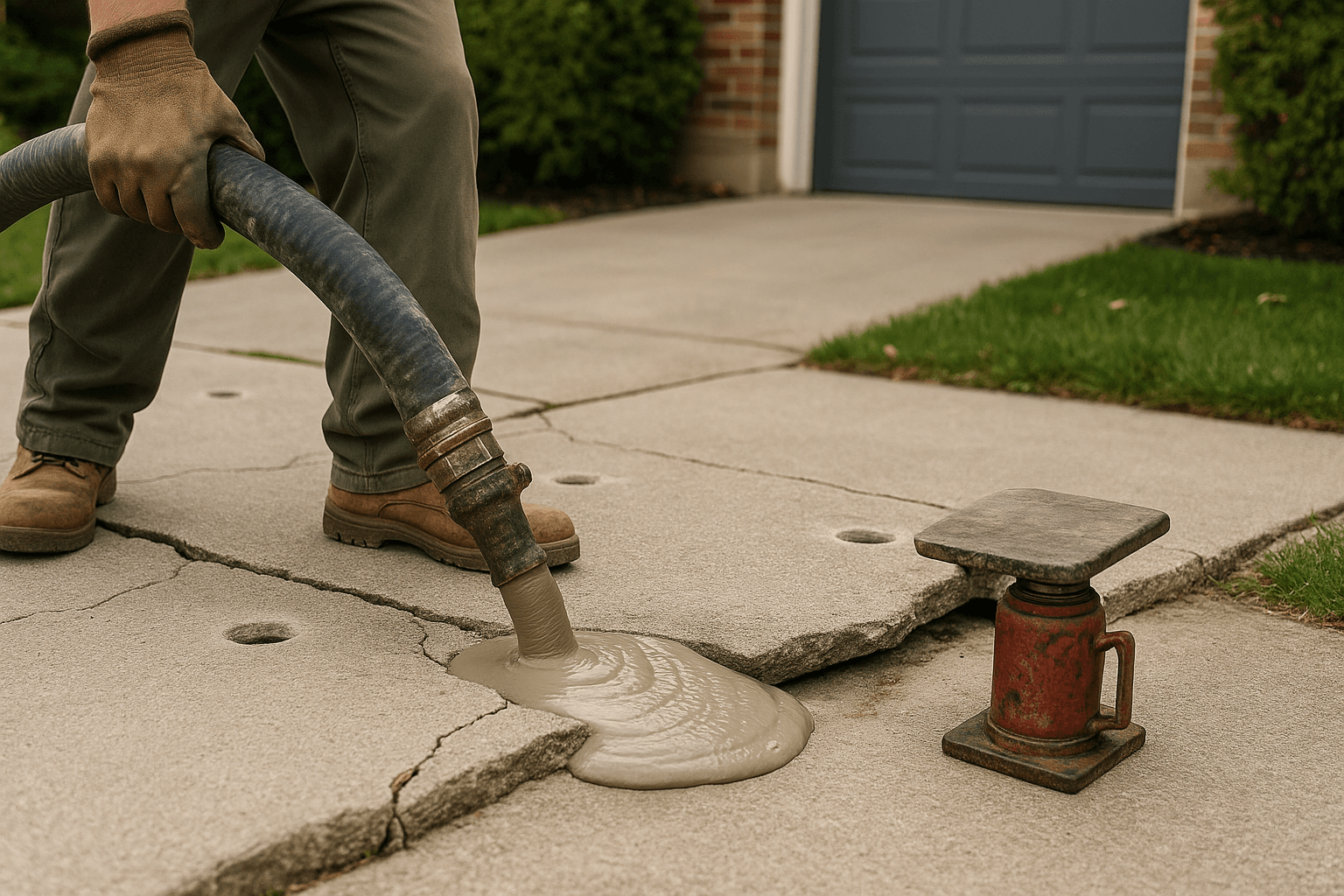
Here is the thing about mud jacking: it is incredibly effective because it attacks the root of the problem. We aren’t just patching the crack on top; we are filling that empty void underneath. By pumping this mixture under the slab under high pressure, we physically lift the concrete back up to its original position. It’s kind of like pumping up a bicycle tire, but instead of air, we use structural grout, and instead of a tire, it’s a two-ton slab of concrete.
The Dollars and Sense: Why It’s the Economical Choice
Let’s talk money, because that is usually what homeowners are most worried about. Total concrete replacement is expensive. Like, really expensive. You have to pay for the demolition, the hauling away of the old concrete, the new materials, and the labor to pour and finish it. Plus, you’re looking at days, maybe weeks, of your driveway being a construction zone.
Mud jacking usually costs about 50% to 70% less than replacement.
That is not spare change; that is a vacation fund or a significant chunk of a remodel budget. Because we are using the existing concrete—which is usually still structurally sound despite being unlevel—you save on materials and labor.
Here is a quick breakdown of why the wallet prefers mud jacking:
- No Demolition Costs: We don’t have to jackhammer your driveway into oblivion.
- Less Labor: The job is usually done by a small crew in a few hours.
- Zero Disposal Fees: You aren’t paying to dump tons of old concrete at the landfill.
Time is Money, Too
Speaking of construction zones, nobody wants yellow caution tape across their yard for a week. If you pour new concrete, you have to wait for it to cure. That means parking on the street and hauling groceries halfway down the block for at least a week, sometimes longer if the weather in Utah decides to be difficult.
With concrete lifting, the turnaround is fast. You can usually walk on the driveway immediately after we finish, and you can drive your car on it within 24 to 48 hours.
Comparison of Driveway Repair Methods
| Feature | Mud Jacking | Total Replacement |
|---|---|---|
| Cost | Low (Economy Choice) | High |
| Time to Fix | 2-4 Hours | 2-5 Days |
| Ready to Use | Same Day / Next Day | 7-28 Days (Cure time) |
| Mess Factor | Minimal Dust/Cleanup | High (Demolition debris) |
| Landscape Impact | Low impact on grass | High risk to nearby sod |
The Process: How We Do It
You might be wondering, “Is this going to tear up my lawn?” Honestly, it’s pretty surgical. Here is a rough sketch of how a typical job goes down with Mud Dog Jacking.
- Drilling: We drill small holes (about the size of a quarter or a little larger) strategically through the sunken slab. We try to keep these neat and tidy.
- Pumping: We hook up a hose to our hydraulic pump and inject the slurry mixture through the holes. This fills the voids first. Once the space is full, the pressure builds up and gently pushes the slab upward.
- Leveling: This is the art form. We monitor the lift carefully to ensure it aligns perfectly with the surrounding concrete.
- Patching: Once everything is level, we clean out the holes and patch them with fresh cement. After it dries, the holes are barely noticeable—certainly better looking than that giant trip hazard you had before.
The Ogden Factor: Winter is Coming (Or It’s Already Here)
Living in Ogden, we have to deal with freeze-thaw cycles. This is practically the state sport of Utah weather. Water gets into cracks during the day, freezes at night, expands, and pushes the concrete around. Then it melts, leaves a gap, and the cycle repeats.
If you leave a sunken slab alone through a winter, you are asking for trouble. That depression allows water to pool. When that pool freezes, it acts like a wedge, potentially cracking the slab further or causing the surface to spall (chip away).
Fixing the grade through mud jacking ensures proper drainage. If the water runs off your driveway instead of sitting on or under it, your concrete will last years longer. It’s preventive maintenance. You know what they say: an ounce of prevention is worth a pound of cure (and a few thousand dollars in new concrete).
Is Mud Jacking Always the Answer?
Look, I’d love to tell you we can fix absolutely anything, but I want to be straight with you. There are times when replacement is actually necessary.
If your driveway looks like a shattered puzzle piece—we call this “alligator cracking”—mud jacking won’t help much. We can lift the pieces, sure, but they will still be loose, broken pieces. In that case, the structural integrity is gone, and you really do need a fresh pour.
Also, if the concrete is crumbling into dust because of bad mixing years ago, lifting it won’t stop it from deteriorating. But for the vast majority of cases—where the slab is mostly solid but just settled at an angle—mud jacking is the gold standard for repairs.
A Note on “DIY”
I’ve seen some videos online where people try to lift slabs themselves using car jacks or expanding foam from a hardware store can. Can I just say? Please don’t.
Concrete is dangerously heavy. A standard driveway slab can weigh several thousand pounds. If it slips or breaks while you have a jack under it, it can be disastrous. Plus, the “foam in a can” stuff isn’t designed for that kind of load-bearing. You need the hydraulic pressure and the specialized slurry to ensure the void is completely filled. If you only fill half the void, the slab will crack right down the middle the first time you park your truck on it.
Keeping It Green
There is another angle we don’t talk about enough: the environmental impact. When you replace a driveway, the old concrete ends up in a landfill. It sits there forever. By choosing to lift and repair, you are recycling the existing material.
Furthermore, the slurry we use at Mud Dog Jacking is made of natural materials. It’s earth-friendly stuff. So, you save money, save time, and save a little bit of landfill space. That feels like a win-win-win scenario, doesn’t it?
How Long Does It Last?
This is the big question. If we pump it up, will it just sink again next week?
Generally, no. The slurry we pump in is solid. However, the longevity depends on why it sank in the first place. If your downspouts are still dumping water right next to the driveway, the soil might wash out again eventually. Part of our job is to help you identify those drainage issues so you can fix them.
If you handle the water drainage properly, a mud jacking job can last for the remaining life of the concrete. We are creating a new, stable base that is often stronger than the dirt that was there before.
Let’s Fix That Driveway
At the end of the day, your home is your biggest investment. You maintain the roof, you paint the walls, so why let the driveway turn into an obstacle course? It’s not just about aesthetics; it’s about safety and protecting the foundation of your property.
You don’t have to live with uneven Steps, sinking garage aprons, or trip hazards on your walkway. The solution is faster, cleaner, and much cheaper than you probably thought.
If you are in Ogden or the surrounding area and you’re tired of tripping over that one uneven slab, give us a shout. We’d love to come take a look and give you an honest assessment of whether mud jacking is the right fit for your home. Call us today at 801-644-9122 to get started. Request a Free Quote and let’s get that concrete back on the level.