Walking out to your Driveway with a cup of coffee only to catch your toe on an uneven slab is a pretty terrible way to start a morning in Ogden. It’s frustrating to watch your home’s Curb appeal literally sink into the ground, but honestly, the thought of ripping everything out and pouring new cement sounds like an expensive nightmare. The good news is that you usually don’t have to start over; Concrete Lifting is a faster, cleaner, and much cheaper alternative that saves your existing slab.
So, Why Is Your Concrete Sinking Anyway?
Here’s the thing about living along the Wasatch Front—the ground moves. A lot. It’s not just about how well the concrete was poured originally; it’s about what is happening underneath it. You know how our seasons go here? We get those scorching dry summers and then deep, freezing winters. That creates a massive freeze-thaw cycle.
When water gets under your driveway or Sidewalk, it freezes and expands, pushing the slab up. Then it melts, and the soil shrinks or washes away. Over time, this creates voids—empty pockets of air where dirt used to be. Eventually, gravity wins. The concrete has nothing to rest on, so it settles.
Sometimes it’s just poor compaction from when the house was built. If the contractor didn’t pack the dirt down hard enough back in the day, it slowly compresses over years. It’s annoying, sure, but it’s just physics. The slab itself is usually fine; it just needs a little help getting back to level.
The Mud Jacking Concept: A Quick Primer
Before we walk through the actual Steps, let’s clear up what we are actually talking about. You might hear terms like mud jacking, slab jacking, or Concrete Leveling. For the most part, these refer to the same general concept with slightly different materials.
Think of it like inflating a tire, but instead of air, we are pumping a material underneath the concrete to push it up.
Traditionally, “mud jacking” uses a slurry—a mixture of water, dirt, and cement. It’s thick, heavy, and strong. There’s also polyurethane foam lifting, which uses a chemical foam that expands. Both methods aim to fill those voids I mentioned earlier and hydraulically lift the slab back into place. At Mud Dog Jacking, we focus on the method that gets you the most stability for the distinct soil types we have here in Ogden.
Step 1: Preparation and Drill Work
Okay, let’s get into the nitty-gritty of how we actually fix this. You don’t need to move out, and you don’t need to park on the street for a week.
The first thing we do is assess the pattern of the settlement. We need to figure out exactly where the voids are. Once we have a game plan, we drill holes.
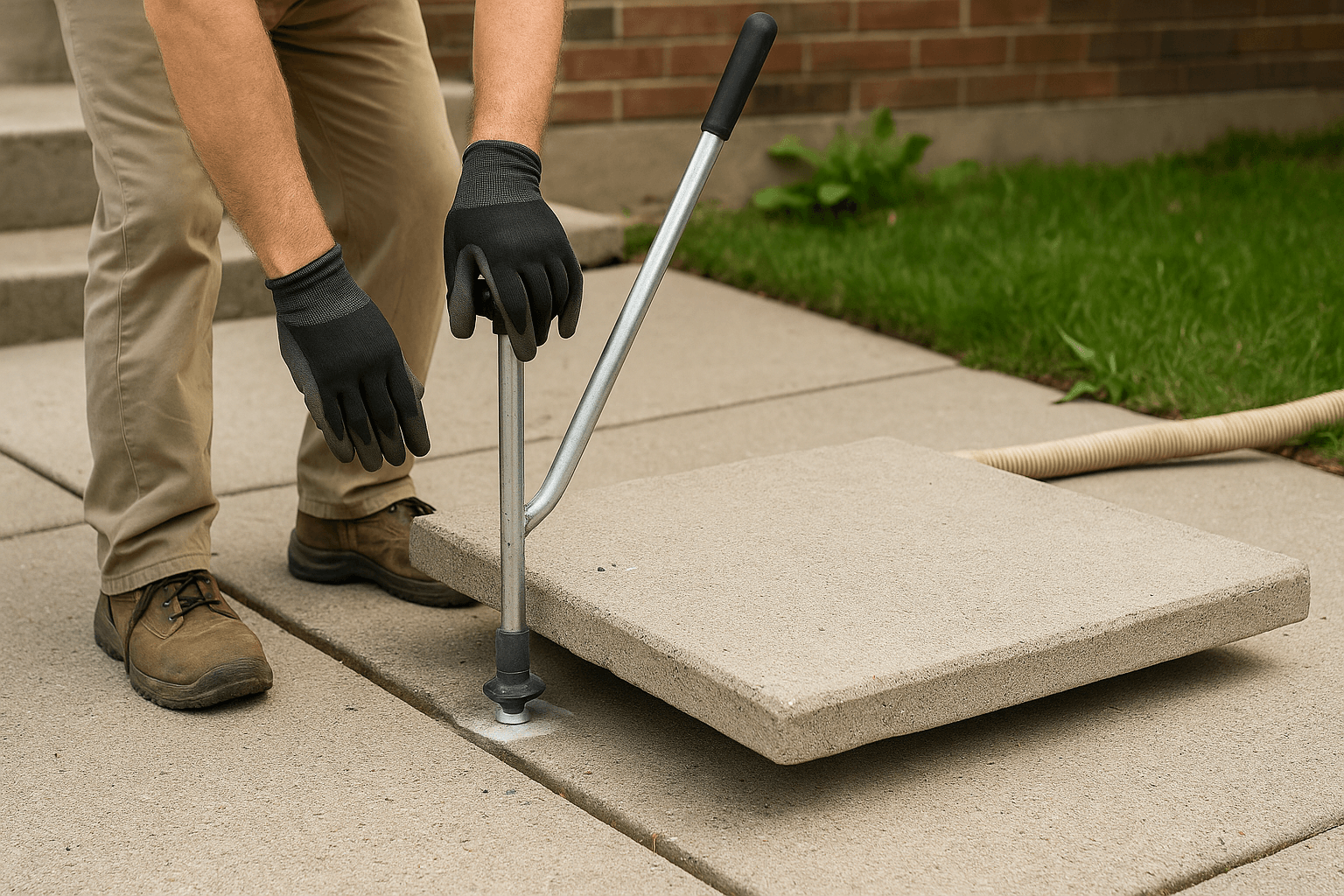
Now, don’t panic. We aren’t destroying the slab. We drill a series of strategically placed holes through the sunken concrete.
- The Size: These holes are small. If we are doing traditional mud jacking, they might be about the size of a soda can rim or slightly smaller. If it’s poly, they are even tinier, like the size of a dime.
- The Location: We don’t just Swiss-cheese your driveway. We drill into specific pressure points that will allow the material to flow evenly and lift the slab uniformly.
It’s a bit noisy for a few minutes—drilling through concrete always is—but it’s quick.
Step 2: The Lift (The Magic Part)
This is the part everyone likes to watch. It’s actually pretty satisfying.
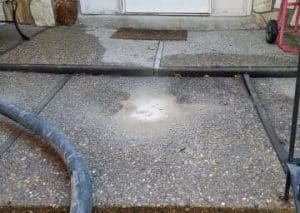
We hook up a hydraulic pump to those holes we just drilled. A hose delivers our mixture—the “mud” or slurry—deep underneath the slab.
Here is what happens underground:
- Filling the Voids: First, the material flows into all those empty spaces caused by erosion or settling. It has to fill the cavity completely before anything else happens.
- Building Pressure: Once the space is full, the mixture becomes pressurized. It has nowhere else to go, so it starts pushing against the solid concrete slab.
- The Rise: Slowly, carefully, the concrete starts to lift.
We don’t just blast it up. It takes a trained eye to control the lift. We raise it in small increments, checking the level constantly to ensure it aligns perfectly with the surrounding concrete (or your Garage Floor). If you lift too fast, you could crack the slab, and nobody wants that. It’s a delicate balance of hydraulic pressure and patience.
Step 3: Patch and Cleanup
Once the slab is back where it belongs—flush and level—we stop pumping. But we can’t just leave holes in your driveway.
We clean out the injection holes and fill them with a high-strength concrete patch mixture. We do our best to match the color and texture of your existing concrete, though keep in mind, concrete fades over time so new patch material might look a little fresh for a while.
After that? We wash down the area. Since there was no demolition, there’s no rubble to haul away. No dumpsters in your front yard. Honestly, aside from the patch marks (which fade), you’d hardly know we were there—except that you stop tripping over that ledge every time you walk to the mailbox.
Repair vs. Replacement: A Reality Check
You might be thinking, “If the ground is bad, shouldn’t I just tear it out and start over?”
I get that logic. New feels better, right? But in the world of concrete, “new” comes with a hefty price tag and a lot of headaches. Unless the concrete is crumbled into gravel, replacement is usually overkill.
Here is a quick breakdown of why concrete lifting usually wins out for Ogden homeowners:
| Feature | Concrete Lifting (Mud Jacking) | Concrete Replacement |
|---|---|---|
| Cost | Generally 50-70% cheaper | Expensive (Labor + Materials + Disposal) |
| Time | Completed in a few hours | Takes days (Demo, Forms, Pour, Cure) |
| Use | Walk/Drive on it almost immediately | Wait 7-28 days to cure fully |
| Landscape | Zero damage to grass/sprinklers | Heavy equipment tears up the yard |
| Mess | minimal dust | Dust, debris, loud jackhammers |
See the difference? When you replace a slab, you are also disturbing the soil underneath again. That means the new slab is just as likely to settle as the old one unless the soil is perfectly compacted. Lifting works with the settled soil, which creates a more stable base in the long run.
When Is Concrete Lifting NOT the Answer?
I want to be straight with you—we can’t fix everything. I wish we could, but there are limits.
If your driveway looks like a shattered puzzle—we call this “alligator cracking” because it looks like reptile scales—lifting won’t help. There are too many small pieces to lift together. In that case, the structural integrity is gone, and you really do need to pour a new slab.
Also, if the concrete has crumbled or the surface is spalling (flaking off) badly, lifting will fix the height, but it won’t fix the ugly surface. We fix the position of the concrete, not the texture.
Why Ogden Soil is Tricky
We briefly touched on this, but it’s worth a second look. The soil in Weber County can be a mixed bag. You have areas with sandy, loamy soil near the river, and then rocky, clay-heavy soil up on the benches.
Clay is particularly notorious. It acts like a sponge. When the snow melts off the Wasatch mountains, that clay absorbs water and swells up. In the dead of August, it dries out and shrinks. This constant movement is rough on rigid materials like driveways and patios.
That is why Mud Dog Jacking uses materials designed to be stable. We aren’t just pumping water back under there; we are creating a solid base that resists washing out the next time we get a heavy spring rain.
Common Questions We Get (And Honest Answers)
“Will the concrete sink again?”
It’s possible, but unlikely to happen quickly. The soil under your home has likely done 90% of its settling already. By filling the void and compacting that sub-base with our slurry, we are fixing the root cause. However, if you have a broken water main washing dirt away, or if you have drainage issues where water pools right next to the slab, it could settle again. Fix your drainage, and the lift will last a long time.
“How long does it take to dry?”
That’s the best part. If we use a cement slurry, you can usually walk on it in a few hours and drive on it within 24 hours. If it’s poly foam, you can drive on it practically as soon as we pack up the truck. Compare that to the weeks of waiting for fresh concrete to cure.
“Is it loud?”
Briefly. The drill sounds like… well, a drill. But we aren’t running jackhammers all day. It’s a minor disturbance, usually over in a couple of hours.
Don’t Ignore the Trip Hazard
Look, I know how home maintenance goes. You see a crack or a sunken step, and you think, “I’ll get to that next year.” But these things don’t get better on their own. In fact, they usually get worse.
A sunken walkway is a liability. It’s a trip hazard for your kids, the delivery driver, or your elderly neighbor. Plus, when concrete settles toward your foundation, it directs water into your basement or crawlspace. That turns a cheap cosmetic fix into a massive structural repair bill.
Fixing your sunken concrete is one of the most cost-effective things you can do to protect your home’s value. It’s quick, it’s clean, and it works. Plain and simple.
You don’t have to live with uneven driveways or dangerous sidewalks any longer. If you’re in Ogden or the surrounding area, give Mud Dog Jacking a call at 801-644-9122 to see how easy it is to level things out. Request a Free Quote today, and let’s get your concrete back on solid ground.