You’ve walked out to grab the mail, stared at that sunken slab of your Driveway, and thought, “I really need to fix that someday.” It’s one of those nagging home maintenance tasks that is incredibly easy to ignore until you trip over it while carrying a load of groceries. Uneven concrete isn’t just an ugly spot on your property; it’s a genuine headache waiting to happen.
Wait, Why Is My Driveway Sinking?
Here’s the thing about living in Ogden: the ground moves. We aren’t exactly floating on a cloud here. Between the soil composition and the weather, the earth beneath your concrete is constantly shifting.
Usually, it comes down to the subgrade—that’s the dirt underneath the concrete. If that soil wasn’t compacted perfectly when the home was built, or if water has been washing it away for years, you get voids. Imagine a cavity in a tooth, but under your Sidewalk. The concrete is heavy. Like, really heavy. If there is empty space underneath it, gravity is going to win every single time. The slab settles, sinks, or tilts.
And honestly? It’s rarely the concrete’s fault. It’s almost always the dirt playing tricks on you.
The “Toe-Stubber” Factor: Safety First
Let’s be real for a second. The biggest reason Concrete Leveling matters is that trip hazards are a nightmare. You might know exactly where that lip in the walkway is, but your mail carrier doesn’t. Your elderly aunt coming for Thanksgiving dinner doesn’t.
If someone trips and takes a spill on your property, that’s a liability issue you do not want to deal with. It sounds dramatic, but people get sued over sidewalks every day. Leveling that concrete removes the lip, smoothing out the transition between slabs so feet shuffle over it rather than catching on it.
Plus, think about your own convenience. Have you ever tried to push a snowblower over a sidewalk that’s heaved up two inches? It stops you dead in your tracks. In the middle of a Utah winter, that is physically jarring and incredibly frustrating.
It’s About More Than Just Looks (But Looks Matter)
We can pretend we don’t care about Curb appeal, but we do. A cracked, sinking driveway makes the whole house look tired. It signals to neighbors—or potential buyers if you’re selling—that the home might have foundation issues, even if it doesn’t.
Curb appeal is real. When your concrete is flush and level, the lines of the landscaping look cleaner. It just feels maintained.
But beyond the aesthetics, there is a structural component to this. When a slab settles, it often cracks because it’s bending in a way it wasn’t designed to bend. Concrete is strong under compression (being squished), but it’s weak under tension (being bent). Once it cracks, water gets in. And in our climate, that is where the real trouble starts.
The Ogden Freeze-Thaw Cycle
You know how the weather is here. One day it’s 50 degrees, the next it’s snowing, and then it melts by noon only to freeze again at night. This is the freeze-thaw cycle, and it is brutal on concrete.
When water gets into those cracks or pools in the sunken areas of your uneven slab, it freezes overnight. Water expands when it freezes. That expansion acts like a hydraulic jack, forcing the crack to open wider or heaving the slab up further.
Then it melts, leaving a bigger gap for more water to enter next time.
By leveling the concrete, you fix the drainage. You want water running off the slab and away from your home, not pooling in a low spot or draining back toward your foundation. That’s a subtle but critical point: proper drainage protects your home’s foundation. If your Patio is tilting toward your house, you are funneling rainwater right where you don’t want it.
Repair vs. Replace: The Financial Reality
This is usually the part where people assume fixing concrete costs an arm and a leg. But there is a massive difference between leveling concrete and replacing it.
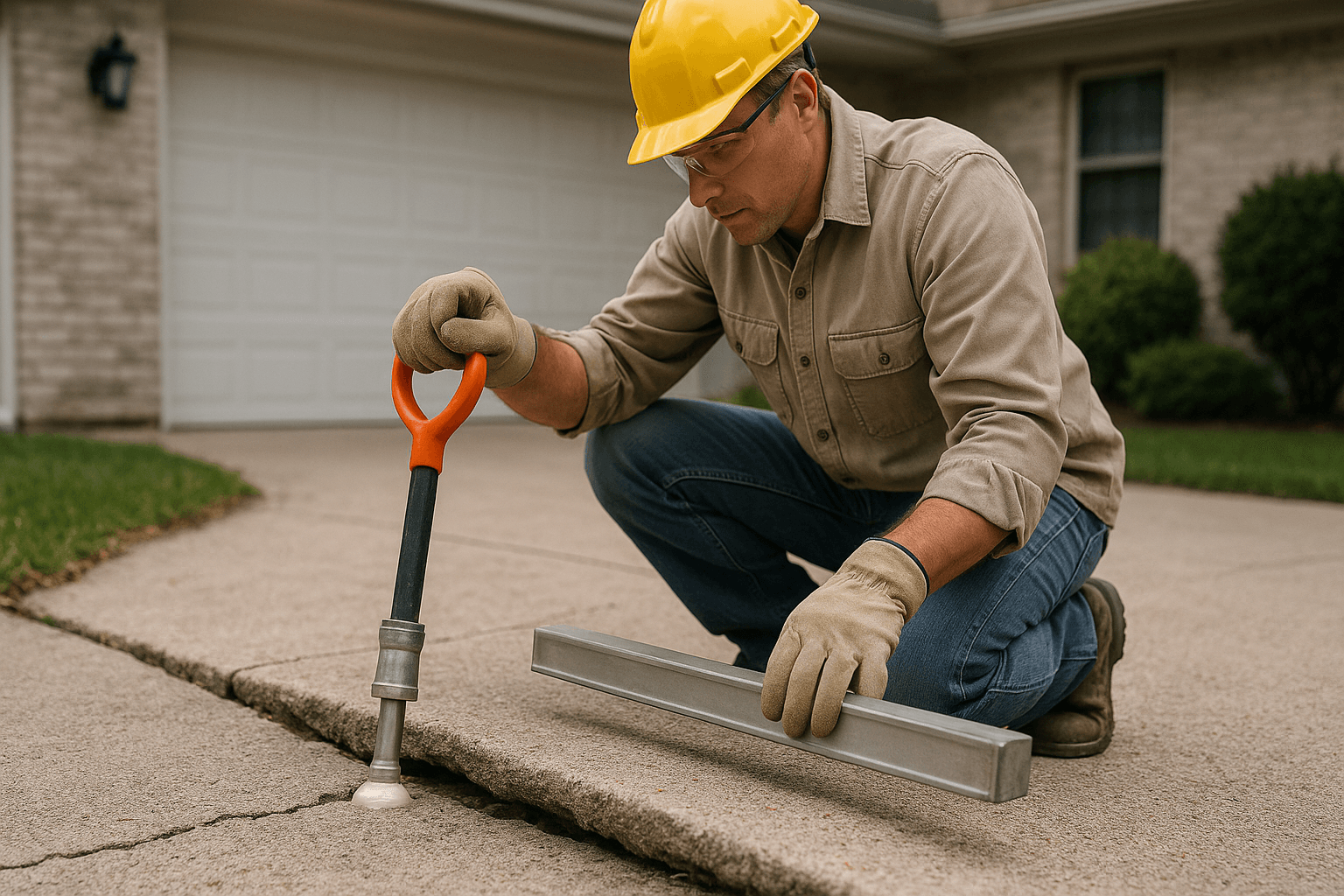
tearing out a driveway is a production. Jackhammers, dump trucks, framing, pouring, waiting for it to cure… it’s a mess. Concrete leveling (often called Mud Jacking or slab jacking) is surgical. We drill small holes, pump a slurry underneath to fill the voids and lift the slab, patch the holes, and leave.
Here is a quick breakdown of why leveling usually wins out:
| Feature | Concrete Leveling | Concrete Replacement |
|---|---|---|
| Cost | Generally 50-70% less than replacement | High material and labor costs |
| Time | Done in a few hours | Takes days (plus cure time) |
| Mess | Minimal dust, no landscape damage | heavy machinery, torn up grass |
| Use | Walk/drive on it almost immediately | Wait days to drive on it |
It’s kind of a no-brainer unless the concrete is pulverized into gravel. If the slab is largely intact, just sunken, leveling is the way to go.
How Does It Actually Work?
It’s surprisingly satisfying to watch. If you’ve never seen it done, it looks a bit like magic.
Technicians drill small holes—about the size of a quarter—strategically through the sunken slab. Then, using a specialized hose, they pump a mixture (often a limestone slurry or similar material) down into the hole.
This material flows into the empty spaces (voids) in the subgrade. Once the voids are full, the pressure builds up. That pressure has nowhere to go but up. It gently pushes the slab back into place. It’s all about hydraulic pressure.
The crew monitors the lift carefully. It’s not just “pump and pray.” They have to lift it slowly to ensure it doesn’t crack further. Once it’s level with the adjacent slab, they stop, plug the holes with new cement, and wash up.
Signs You Need Leveling Now
You might be looking at your walkway thinking, “Is it bad enough yet?” Here are a few signs that you shouldn’t wait:
- Water Pooling: If a puddle forms in the middle of your walkway every time it rains, that slab has settled.
- Hollow Sounds: If you drop something heavy on the concrete and it sounds like a drum, there is a void underneath.
- Doors Sticking: Sometimes, a sinking porch or patio can actually pull on door frames or exterior siding.
- Separation: Look at where your driveway meets the Garage Floor. Is there a bump? Has the driveway pulled away? That’s settlement.
It’s Maintenance, Not Just Repair
We tend to view concrete as a “set it and forget it” material. We think of it like rock—permanent and unchanging. But because it sits on soil, it requires maintenance just like your roof or your gutters.
Neglecting a sinking slab is like ignoring a small leak in the roof. It starts small, maybe just a hairline crack or a quarter-inch dip. But over a few Utah winters, that water infiltration undermines the subgrade even more. The hole gets bigger. The slab sinks deeper. Eventually, the slab snaps in half.
Once the concrete is shattered into multiple, small, shifting pieces, leveling becomes much harder, sometimes impossible. At that point, you are stuck paying for the expensive tear-out and replacement. Proactive maintenance saves your wallet in the long run.
The “Green” Angle
You know what? There’s an environmental side to this, too. When you tear out concrete, that old rubble has to go somewhere. Usually, it ends up in a landfill.
By leveling the existing concrete, you are recycling the slab you already have. You aren’t consuming the massive amount of energy required to mine, transport, and mix new cement. It’s a small thing, but keeping perfectly good building materials out of the dump is a win.
Choosing the Right Help
Not all concrete is the same, and neither are the soils in Ogden. You need someone who understands the local geology. Someone who knows that the soil near the bench is different from the soil down in the valley.
When looking for a fix, you want a team that is honest about whether a slab can be saved. Sometimes, if a slab is too far gone, we have to tell you it needs replacement. But most of the time, we can save it.
Don’t let your driveway become a skate park ramp. Don’t let your front walk become a lawsuit waiting to happen. It’s one of those home improvements that provides instant gratification—you see the results immediately, and you feel the difference the next time you walk to the mailbox.
If you are tired of tripping over that one uneven square of sidewalk or watching your patio slowly drift away from your house, it is time to do something about it.
Get your concrete back on the level. Call Mud Dog Jacking at 801-644-9122 or go online to Request a Free Quote. We’ll help you get your footing back.