There is nothing quite as jarring as coming home after a long day, walking up your Driveway, and catching your toe on an uneven slab of concrete. It spills your coffee, scuffs your shoe, and honestly, it just looks bad. If you are a homeowner in Ogden, you know that our freeze-thaw cycles can wreak absolute havoc on walkways and driveways, turning a smooth entry into an obstacle course.
Why Does Concrete Sink in the First Place?
You might be looking at your Sidewalk and wondering, “How did this happen?” It felt solid when you bought the house. Here’s the thing: concrete is incredibly heavy, but it’s actually not the concrete’s fault. It’s almost always about what lies beneath.
In Northern Utah, we deal with a lot of soil movement. The ground here expands when it gets wet and shrinks back down when it dries out. Over time, this natural cycle—combined with poor compaction when the home was built—creates voids (empty pockets of air) under your heavy concrete slabs. Eventually, gravity wins. The slab has nothing supporting it, so it settles.
Sometimes it happens slowly, just a fraction of an inch a year. Other times, a heavy spring runoff can wash away soil quickly, leading to a sudden drop. It’s frustrating, sure, but it’s also just physics doing its job.
What is Concrete Lifting?
So, your concrete has sunk. Now what? A lot of people assume the only option is to bring in a jackhammer, rip it all out, and pour fresh cement. That sounds expensive, loud, and messy—mostly because it is.
Fortunately, there is a much smarter way to handle this. It’s called concrete lifting, though you might hear it referred to as slab jacking, mudjacking, or Concrete Leveling.
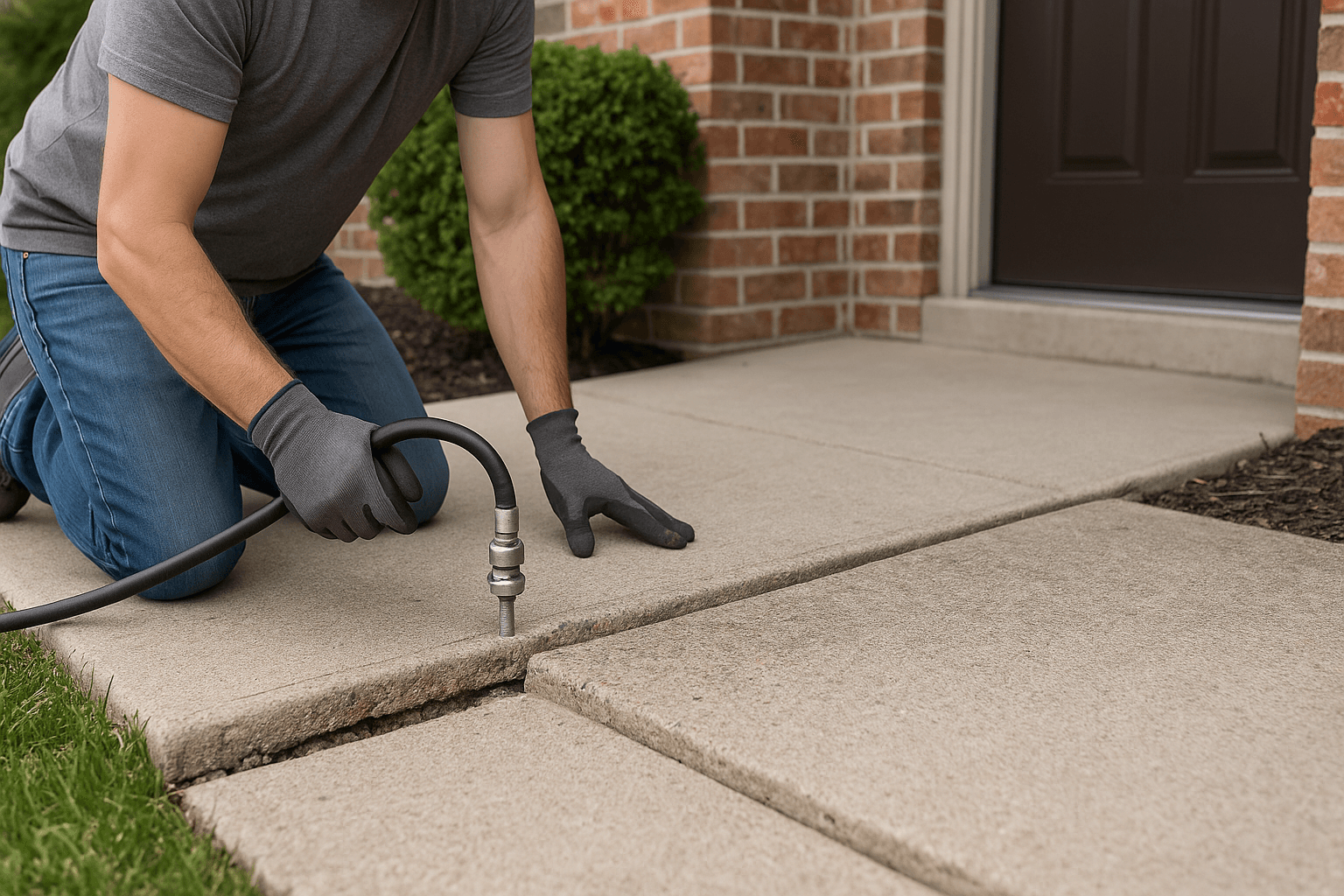
The concept is surprisingly simple, even if the execution requires professional skill. Instead of replacing the slab, we use the existing concrete. By drilling small holes into the sunken sections, we pump a specialized material underneath. This material fills those annoying voids and creates enough pressure to physically lift the slab back up to its original position. It’s like inflating a tire, but the “tire” is a two-ton piece of driveway.
The Different Methods: Mud vs. Poly
When you start looking into lifting, you’re going to run into two main schools of thought. It helps to know the difference so you aren’t nodding along blindly when a contractor starts talking shop.
There is traditional mudjacking, and then there is the newer polyurethane foam lifting (often called polyjacking). Both achieve the same goal—a level surface—but they go about it differently.
| Feature | Mudjacking (Traditional) | Polyjacking (Polyurethane) |
|---|---|---|
| Material | A slurry of sand, cement, and water | expanding structural foam |
| Hole Size | Larger (about the size of a soda can lid) | Smaller (about the size of a penny) |
| Cure Time | 24-48 hours before driving on it | Almost immediate (15-30 minutes) |
| Weight | Heavier (adds mass to the soil) | Lightweight (doesn’t burden the soil) |
Which one is better? Honestly, it depends on the specific job. Mudjacking has been around for decades and is fantastic for filling large voids because the material is inexpensive and sturdy. Polyjacking is great for sensitive areas where you don’t want to add more weight to already soft soil.
It’s Not Just About Curb Appeal
Let’s be real for a second. Most of us ignore home maintenance issues until they start looking ugly. But uneven concrete is more than just an eyesore; it is a legitimate liability.
Think about the delivery driver dropping off your packages, or your neighbor coming over during an icy Ogden winter. If that walkway has settled an inch or two, it creates a serious trip hazard. In the world of insurance and liability, that trip hazard is your problem.
Beyond safety, there is the issue of water drainage. Concrete surfaces are usually graded (sloped) to encourage water to run away from your house. When a slab sinks, that slope can reverse. Now, instead of rain flowing into your lawn or the street, it might be pooling right against your foundation. Over time, that leads to basement leaks, mold, and foundation cracks that cost a fortune to fix. Spending a little on concrete lifting now prevents spending a massive amount on structural repair later.
Can I Just DIY This?
I get it. You’re handy. You’ve got a garage full of tools. You might be thinking, “I can just buy some cold patch or self-leveling sealant at the hardware store and ramp it out.”
Please, don’t.
Here is why that usually backfires. Putting a patch on top of a sunken slab doesn’t fix the root problem. Remember the voids underneath? They are still there. The slab is going to keep settling, and that patch is going to crack and crumble within a season or two. Plus, let’s be honest, those patches never match the color of the original concrete. It ends up looking like a bandage on a broken leg.
Concrete lifting requires specialized pumps and hydraulic equipment. It involves pressurized injection that can literally lift a car if you aren’t careful. It’s one of those jobs where the margin for error is slim, and the consequences of messing up involve ruined driveways.
The “Smooth Entry” Checklist
How do you know if you are a candidate for lifting versus needing a total replacement? Generally, if the concrete is still in decent shape—meaning it’s not crumbled into gravel—it can be lifted.
Look for these signs around your property:
- The Garage Lip: You feel a bump every time you pull the car in.
- The Front Walk: One square is significantly lower than the one next to it.
- Patio Tilt: Your patio furniture feels like it’s sliding toward the garden.
- Steps Pulling Away: The concrete stairs have a gap between them and the porch.
If you see these, you are likely in the “sweet spot” for lifting. It’s cheaper, faster, and less disruptive than ripping everything out.
What to Expect on Service Day
If you decide to go ahead with Mud Dog Jacking, you might be wondering what the actual day looks like. Do you need to move out? erraticate your pets?
Not really. It’s surprisingly low-impact.
First, the crew drills a series of strategic holes. It looks a bit like they are preparing to play a game of connect-the-dots. Then, they hook up the hose and start pumping the material. This is the cool part. You can actually watch the concrete slab slowly rise. It’s slow and controlled. They check the levels constantly to ensure it aligns perfectly with the adjacent slabs.
Once it’s level, the holes are patched with a cement mixture. While the patches are visible at first, they fade over time to blend with the existing concrete. The best part? If you use poly, you can walk on it immediately. If it’s mudjacking, you might need to park on the street for a day, but that’s a small price to pay for a smooth driveway.
Saving Money (and the Planet)
We should talk about the cost. Everyone wants to know the bottom line. Generally speaking, concrete lifting costs about 50% to 70% less than replacement. That is huge. If a new driveway costs $8,000, lifting might cost you $2,500. That’s money you can put toward something more fun, like a vacation or literally anything else.
There is also an environmental angle here. Concrete production is energy-intensive. By saving your existing slabs, you keep that old concrete out of the landfill. You aren’t consuming the resources needed to mix, transport, and pour new cement. It’s a form of recycling that happens right in your front yard.
Preventing Future Sinking
Once you get your concrete fixed, you want it to stay that way. While you can’t control the geology of Ogden, you can control water. Water is the enemy of a stable subgrade.
Make sure your downspouts are extending at least five feet away from your driveway and walkways. You want to keep the soil under your concrete relatively dry. If the soil gets saturated, it gets soft. If it gets soft, the heavy concrete sinks. It’s that simple.
Also, keep an eye on the caulking between your slabs. That flexible sealant isn’t just there for looks; it prevents water from washing under the slab and eroding the soil. If the caulk is cracked or missing, replace it. It’s a cheap maintenance task that saves you headaches down the road.
The Emotional Benefit of a Level Ground
You know, there is a subtle psychological effect to fixing up your home exterior. It’s called pride of ownership. When you drive up and the lines are clean, the driveway is level, and the walkway is safe, you feel better about your home. It’s one less thing on your mental “to-do” list nagging at you.
Plus, if you are ever thinking of selling, the driveway is the very first thing a buyer sees. A sunken, cracked driveway screams “foundation issues” to a nervous buyer, even if the house is perfectly sound. Fixing it is an easy win for curb appeal.
Why Expertise Matters
This isn’t just about pumping mud into a hole. It’s about understanding hydraulic pressure and soil dynamics. If you pump too much in one spot, you can crack the slab in half. If you don’t pump enough, it will settle again in a month.
Professionals know how to “read” the concrete. They know where the voids are likely hiding. They know how the specific soil in Ogden behaves differently than soil in, say, St. George. That local knowledge is invaluable.
Final Thoughts on Your Concrete
Don’t let a sunken driveway trip you up—literally or financially. It is one of those home repairs that looks daunting but is actually quite manageable if you catch it in time. You save money, you improve safety, and you restore the look of your home without the chaos of a construction crew tearing up your yard for a week.
If your concrete has settled, it’s time to bring it back up to where it belongs. At Mud Dog Jacking, we specialize in getting your home back on the level. Give us a call at 801-644-9122 or visit our website to Request a Free Quote. Let’s smooth things out.