There is nothing quite as annoying as stepping out onto your Patio with a cup of coffee only to trip over an uneven slab of concrete. It turns what should be a relaxing morning moment into a frustration, reminding you that the ground beneath your feet isn’t as stable as you thought. Before you start panicking about ripping everything out, let’s talk about a smarter way to handle that sinking feeling.
Why on Earth is My Patio Sinking?
It’s the question everyone asks first. Honestly, it usually comes down to what is going on underneath the slab rather than the concrete itself. Here in Ogden, we deal with some pretty specific soil conditions. You have soil that loves to shift around depending on how much moisture is in the ground.
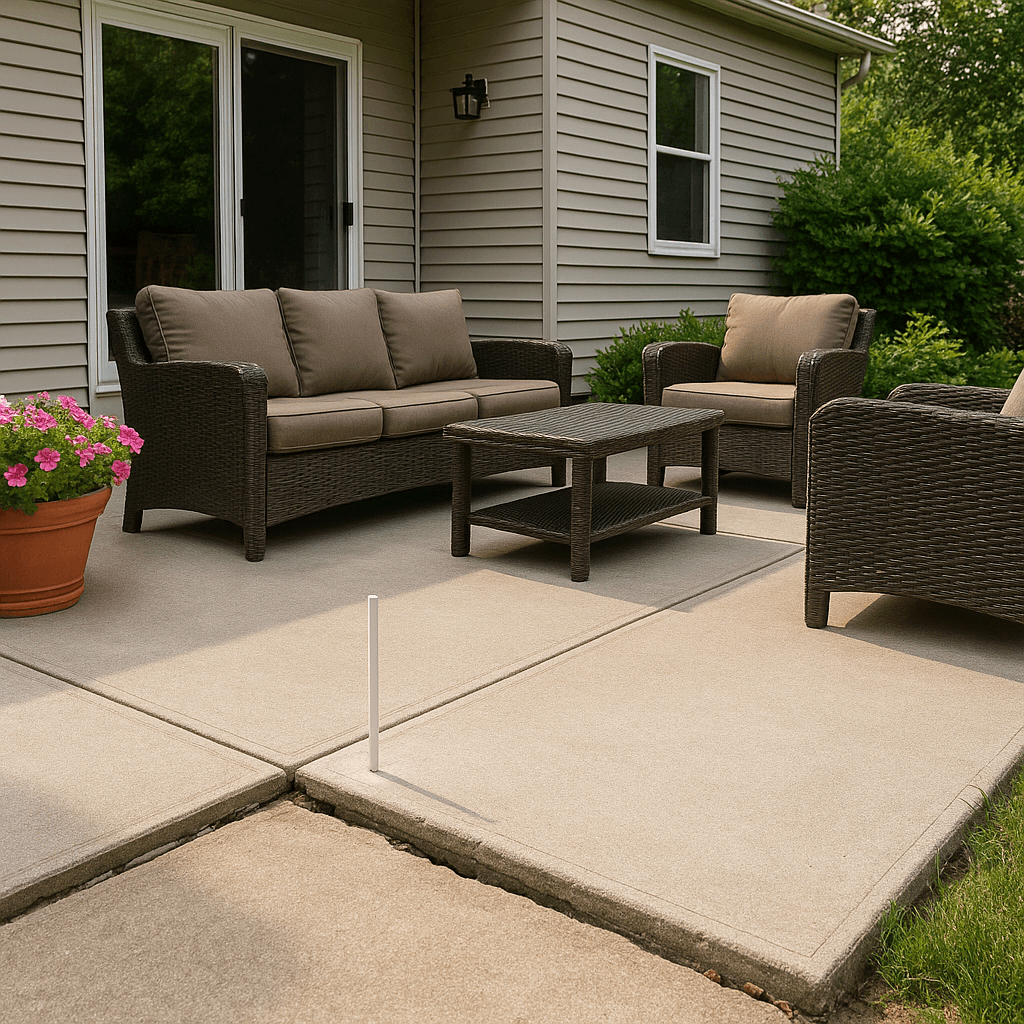
When the soil under your patio gets wet, it can expand, and when it dries out, it shrinks. Over time, or after a few harsh Utah winters, this cycle creates voids—basically pockets of empty air—underneath the concrete. Gravity does the rest. The heavy slab settles into those empty spaces, and suddenly you have a trip hazard or a patio that tilts toward your foundation instead of away from it.
And you know what? It’s not just nature. Sometimes it is poor compaction from when the home was built. If the dirt wasn’t packed down tight enough ten years ago, it is definitely settling now.
Let’s Talk About “Jacking”
You might hear terms like Mud Jacking, slab jacking, or Concrete Lifting thrown around. They sound a bit intense, like you need heavy machinery and a construction crew living in your yard for a week. But it is actually surprisingly low-impact.
Here is the thing: concrete lifting is exactly what it sounds like. We are lifting the existing concrete back to its original position. We do this by pumping material underneath the slab to fill those voids I mentioned earlier. As the material fills the space, it creates pressure that gently pushes the slab back up.
There are generally two ways this gets done:
- Traditional Mud Jacking: This uses a slurry mixture—usually sand, water, and cement. It’s pumped through holes drilled in the concrete. It’s strong, natural, and has been the industry standard for a long time.
- Polyurethane Foam Lifting: Often called “Poly Jacking.” This uses a high-density expanding foam. It is lighter than the slurry but incredibly strong once it cures.
Both methods have their place, but the goal is the same: restore stability without the demolition.
Why You Should Care About The Cost (and the Mess)
If you have ever hired a contractor to pour new concrete, you know it is an ordeal. There is the jackhammering, the hauling away of broken chunks, the framing, the pouring, and then the waiting. You can’t walk on it for days. It’s a whole production.
Comparing that to concrete lifting is almost unfair. Let’s break it down because the difference is huge.
| Feature | Tear Out & Replace | Concrete Lifting |
|---|---|---|
| Cost | High (Labor and materials are pricey) | Affordable (Usually 50-70% less) |
| Time | Days or even weeks | Hours (Done in one afternoon) |
| Mess | Dust, debris, destroyed grass | Minimal (Cleanup is a breeze) |
| Use | Wait days to cure | Walk on it immediately |
It is kind of a no-brainer. Unless your concrete is pulverized into gravel, lifting is almost always the smarter financial move. Plus, you aren’t sending perfectly good concrete to the landfill, which is a nice bonus.
The Process: What Actually Happens?
So, you decide to call Mud Dog Jacking. What does that day actually look like? I think people get nervous that it’s going to be loud or intrusive, but it’s actually pretty surgical.
First, we drill small holes in the affected slabs. If we are doing traditional mud jacking, these holes are about the size of a soda can top. If it’s poly, they are even smaller, like the size of a penny. We place these strategically so the material spreads evenly.
Then comes the lift. We hook up a hose to the port and start pumping. This is the cool part—you can actually watch the concrete rise. It’s a slow, controlled movement. We monitor it constantly to make sure it levels out perfectly with the adjacent slabs.
Once it’s level, we stop. We patch the small holes with fresh concrete, clean up the dust, and that’s it. You can put your patio furniture back right away.
The Ogden Factor: Freeze and Thaw
We need to touch on why this is so important specifically for us here in Northern Utah. We get that lovely freeze-thaw cycle. In the winter, water gets into cracks or under the slab. When it freezes, it expands. Ice is powerful stuff—it can heave a slab up an inch or two overnight.
When spring comes and that ice melts, the ground softens, and the slab drops. Repeat this for five years, and your patio looks like a skate park.
By filling the voids underneath with a solid material, you are displacing the water. If there is no room for water to pool under your concrete, there is less chance of ice forming and heaving the slab around. It stabilizes the whole area. So, getting this done isn’t just about fixing the aesthetics today; it’s about protecting your home against the next winter.
Safety First (But Looks Matter Too)
I’ll be honest, most people call us because they are tired of looking at an ugly crack or a sunken corner. And that’s valid! You want your home to look good. A level patio just feels cleaner and more inviting. It’s hard to host a barbecue when the grill is listing to the left and guests are tripping over the control joint.
But the safety aspect is real. Uneven concrete is one of the most common causes of trips and falls at home. If you have elderly parents visiting, or kids running around like maniacs, a raised edge of just half an inch is enough to cause a bad fall.
There is also the issue of water drainage. Patios are designed with a slight slope to shed water away from your house. When a slab sinks, that slope often reverses. Now, every time it rains or snow melts, water runs toward your foundation. That can lead to basement leaks, which is a nightmare you definitely want to avoid. Fixing the patio is a lot cheaper than fixing a flooded basement.
Digressing a Bit: The Value of Outdoor Living
You know, since we are talking about patios, have you noticed how much more we are all using our outdoor spaces lately? It feels like in the last few years, the backyard has become a second living room. People are putting in fire pits, nice furniture, maybe a smoker.
When the foundation of that space—the literal concrete—is failing, it ruins the vibe. It makes the whole space feel neglected. Investing in level concrete is really investing in your summer evenings. It’s about being able to walk out with a tray of drinks and not having to navigate a topographical map of hazards.
Plus, if you are ever thinking of selling, savvy buyers look at the concrete. They see a sunken Driveway or patio and see dollar signs for repairs. A level slab checks a box for them and removes a negotiation point.
Why Mud Dog Jacking?
Look, there are general contractors who will offer to pour new concrete, and there are guys with a truck who might offer a quick patch. But concrete lifting is a specialty. It requires reading the concrete, understanding the soil flow, and knowing exactly when to stop pumping pressure.
At Mud Dog Jacking, we specialize in this. We know the local soil in Ogden. We know how the weather affects the cure times and the settling. We aren’t just pumping goop into the ground; we are engineering a solution to stabilize your home. We treat your backyard like it’s our own—meaning we don’t leave a mess, and we don’t call it done until it’s right.
Don’t Wait Until It Cracks
Here is a little insider tip: concrete has a breaking point. If a slab is unsupported underneath because of a void, it can bridge that gap for a while. But eventually, the weight of a person, a car, or just its own weight will cause it to snap.
Once the concrete cracks straight through, lifting becomes harder. We can still do it, but that crack will always be there (unless you caulk it, which we can discuss). It is much better, and often cheaper, to lift the slab before it breaks. If you notice a hollow sound when you walk on your patio, or see slight settling, that is the time to act.
So, don’t let a sinking patio ruin your outdoor fun or threaten your foundation. It is an easy fix that saves you money and restores your home’s Curb appeal instantly. Call us today at 801-644-9122 to discuss your project. We are ready to help you get back on solid ground—Request a Free Quote now and let’s get that patio perfect.