There is nothing quite like the feeling of pulling into your Driveway after a long day, only to feel that distinct thump as your tires hit an uneven slab. You know the one. It’s that annoying ridge that spills your coffee or makes you worry about your suspension. If you live around here in Ogden, you know that our weather doesn’t exactly play nice with concrete. Between the freezing winters and the baking summers, the ground beneath our homes is constantly shifting, and frankly, your driveway is often the first victim.
Why Is My Driveway Sinking?
Before we get to the fixes, we have to talk about the dirt. It sounds boring, I know, but stick with me. The soil under your driveway is responsible for holding up tons of weight. Here along the Wasatch Front, we deal with a phenomenon that wreaks havoc on concrete: the freeze-thaw cycle.
When snow melts or spring rains hit, water seeps into the soil. Then night comes, the temperature drops, and that water freezes. Ice takes up more space than water, so it pushes the concrete up (heave). When it melts, it leaves a gap. Over time, that soil gets washed away or compacted, creating empty pockets called voids.
Once you have a void, gravity takes over. The concrete slab has nothing supporting it, so it cracks and settles. It’s not necessarily that your concrete was poured badly; it’s just that the earth moves. It’s frustrating, sure, but it’s also fixable without ripping the whole thing out.
The “Easy” Tips for Prevention
You might be thinking, “Okay, but how do I stop it?” While you can’t control the weather or the geology of Ogden, there are some surprisingly simple things you can do to slow down the sinking. These are the driveway maintenance tips that most homeowners overlook until it’s too late.
1. Seal Those Cracks and Joints
Water is the enemy. It really is that simple. If water can get under your slab, it will wash away the soil. The easiest preventative measure? Caulk and seal.
Take a walk down your driveway. Look at the expansion joints (the lines cut into the concrete) and check for any hairline cracks. If you see gaps, that’s a doorway for water. You can head to the local hardware store and pick up a high-quality polyurethane sealant. It’s flexible, so it moves with the concrete rather than cracking again.
2. Check Your Downspouts
This is a big one. I see so many houses where the gutter downspout dumps water right onto the corner of the driveway. That is a recipe for disaster. You are essentially pressure-washing the soil out from under that specific slab every time it rains.
Get an extender. They are cheap, plastic, and easy to install. Divert the water at least five feet away from the concrete. Ideally, run it out to the lawn or a drainage area. It’s a five-minute fix that can save you thousands in repairs.
3. Mind the Edges
If the soil along the edge of your driveway has eroded, water can run right underneath the side. Backfill those edges with dirt or gravel. Keep the grade sloping away from the concrete. It keeps the base stable.
Don’t Replace It, Lift It
Now, let’s say the damage is done. You have a sunken slab, a trip hazard, or a step up into your garage that is three inches higher than it used to be. The old way of thinking was, “Well, I guess I have to jackhammer this up and pour new concrete.”
Honestly? That’s a nightmare. It’s messy, it takes days to cure, and the new concrete will be a bright white color that doesn’t match the rest of your aged driveway. Plus, it’s expensive.
There is a better way. It’s called Concrete Lifting, or leveling. You might hear terms like mudjacking or polyjacking. They aim to do the same thing—raise the slab back to level—but they do it very differently.
The Problem with Old-School Mudjacking
Traditional mudjacking involves pumping a mixture of water, dirt, and cement (a slurry) under the slab. It works, but here is the catch: it’s heavy. If your soil settled because it couldn’t handle the weight of the concrete, adding more heavy material on top of it might just cause it to sink again later. It also requires drilling large holes, about the size of a soda can, into your driveway.
Why Polyjacking Wins
At Mud Dog Jacking, we prefer the modern approach: polyurethane foam lifting.
Think of it like this. Imagine lifting a heavy table. You could shove a pile of rocks under it (mudjacking), or you could slide an industrial-strength airbag underneath and inflate it (polyjacking).
Here is why polyjacking is usually the smarter play for homeowners:
| Feature | Mudjacking | Polyjacking |
|---|---|---|
| Hole Size | Large (1-2 inches) | Tiny (5/8 of an inch) |
| Weight | Heavy (adds burden to soil) | Lightweight (pounds vs tons) |
| Cure Time | Days | Minutes (drive on it immediately) |
| Durability | Can wash away | Waterproof and permanent |
How the Process Actually Works
If you decide to go this route, you might be wondering what the day looks like. It’s actually surprisingly fast. You don’t need to take a week off work or park on the street for days.
Here is the breakdown of the concrete lifting process:
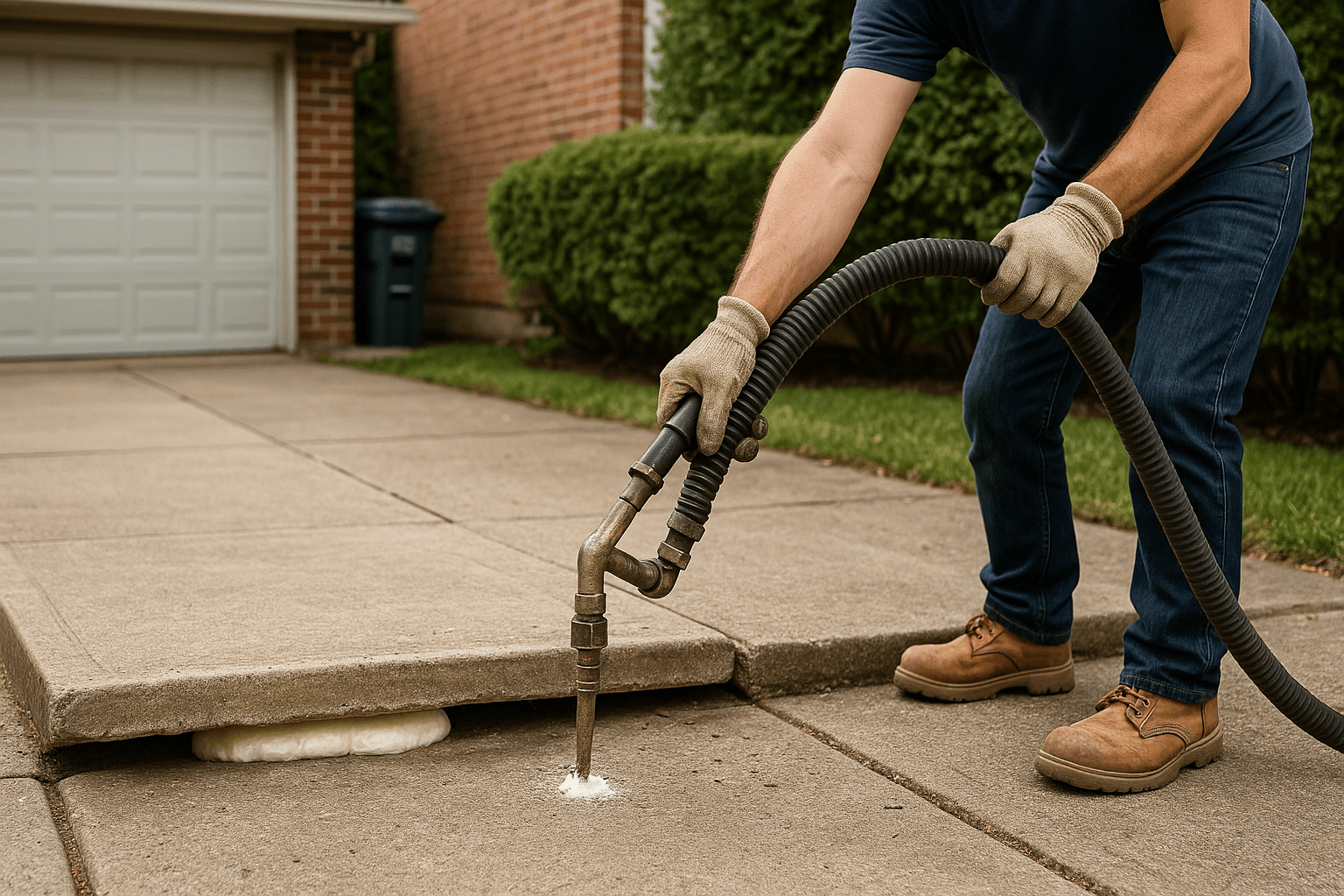
- Drilling: We drill tiny holes, about the size of a penny, in strategic spots on the sunken slab.
- Porting: We insert small injection ports into those holes.
- Pumping: We hook up the hose and inject the two-part polymer foam. This is where the magic happens. The foam starts as a liquid, flows into the voids, and then expands. As it expands, it hardens and lifts the concrete with incredible force.
- Patching: Once the slab is level, we patch the tiny holes with cement. Because the holes are so small, they blend in much better than the giant patches from mudjacking.
You can usually walk on it right while we are working, and you can park your car on it almost as soon as we leave. It’s convenience that you just don’t get with replacement.
The “Stubbed Toe” Test
How do you know if you actually need this? I mean, a little crack gives a house character, right? Maybe. But there is a line between character and liability.
Go out and do the stubbed toe test. Walk normally up your driveway. If you have to unconsciously adjust your stride to avoid tripping over a lip, you have a problem.
It’s not just about aesthetics. In Ogden, we have snow. When you are out there shoveling in the winter, hitting an uneven slab with a snow shovel is jarring. It damages the shovel and hurts your wrists.
Also, consider the safety aspect. If a delivery driver trips on your uneven walkway or driveway, that is a potential lawsuit. If you have elderly relatives visiting or kids running around, those trip hazards are dangerous. Fixing it is usually much cheaper than an insurance deductible.
Why Replacement Isn’t Always the Answer
I hinted at this earlier, but let’s look closer at the cost. Ripping out a driveway and pouring a new one is labor-intensive. You are paying for demolition, hauling away debris, new materials, and a crew to finish the concrete.
Concrete lifting typically costs about half—sometimes even less—of what replacement costs.
Plus, there is the factor of matching. Concrete changes color as it ages. It absorbs oil, dirt, and minerals from the water. If you replace just one square of your driveway, it will stick out like a sore thumb. It will look like a patch job. When you lift the existing concrete, you keep the consistent look of your driveway. You are just putting it back where it belongs.
Dealing with the Water Afterward
Once you have had the driveway lifted, you have to go back to those prevention tips. The lift fills the void, but if you don’t stop the water from getting back under there, nature will try to undo our work.
We always recommend that homeowners seal the joints immediately after a lift. The foam we use is waterproof—it won’t wash away like mudjacking slurry—but the soil under the foam can still move if water is flowing like a river beneath it.
It’s a partnership. We provide the lift and stabilize the slab; you manage the water flow. Together, we keep your driveway flat for years.
A Note on “DIY” Kits
You might have seen videos online of people trying to lift concrete themselves with spray foam cans or questionable rigging systems. Let me be real with you: don’t do it.
The foam we use isn’t the stuff you buy at the hardware store to fill gaps in your window frames. It is an industrial-grade, high-density polymer that generates heat and immense pressure. If you don’t know what you are doing, you can over-lift the slab, crack it in half, or blow out the side of your driveway.
There are some things around the house that are great for DIY. Painting? Go for it. Planting a garden? Absolutely. Hydraulic lifting of multi-ton concrete slabs? Leave that to the folks with the specialized equipment. It saves you money in the long run because fixing a botched DIY job is always more expensive than just doing it right the first time.
Increasing Your Home Value
If you are thinking about selling your home in the near future, the driveway is the first thing a buyer sees. It is the definition of Curb appeal.
A sunken driveway screams “foundation issues” to a potential buyer, even if the foundation of the house is perfectly fine. It scares people off. They see a trip hazard and see dollar signs for repairs.
By having the concrete lifted and leveled, you remove that objection immediately. It shows the home has been well-maintained. It’s a small investment that yields a high return when it comes time to close the deal.
Wrapping It Up
Living in Ogden means dealing with shifting soil. It is just part of the package, along with the great mountain views. But that doesn’t mean you have to live with a jagged, dangerous driveway.
By keeping an eye on your downspouts, sealing your cracks, and opting for modern lifting techniques when things settle, you can keep your home looking sharp and safe. It’s easier than you think, and certainly less of a headache than pouring new concrete.
If your driveway has settled or you are tired of tripping over that one uneven step, let’s get it fixed. We can assess the situation and let you know exactly what’s going on underneath that slab. Give us a call at 801-644-9122 or visit our website to Request a Free Quote. We’ll help you get back on solid ground.