
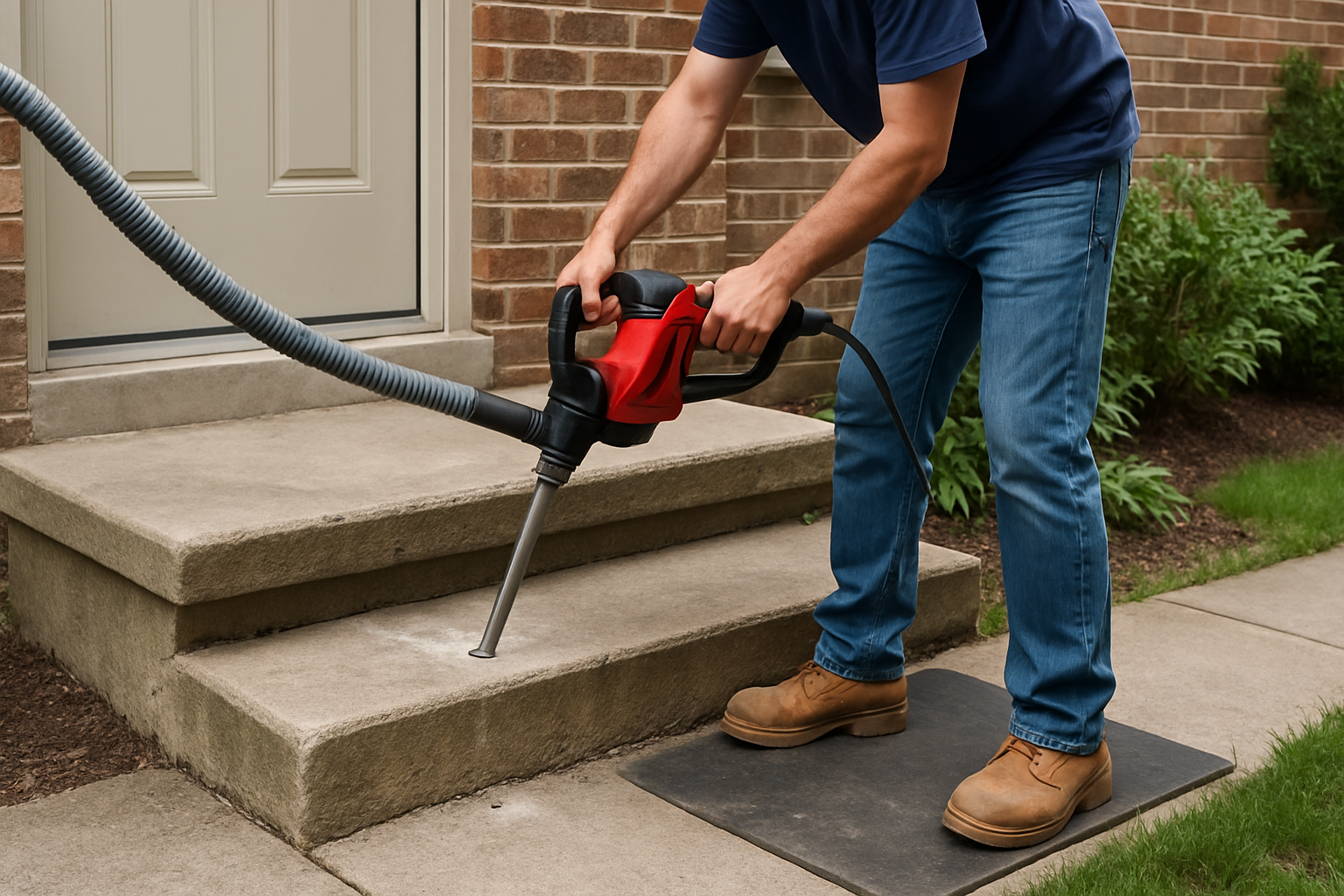
Have you ever walked out your front door and felt like your porch Steps shifted overnight? Honestly, sinking stairs are one of those weird home maintenance issues that sneak up on you until you suddenly trip holding a heavy load of groceries. If you live around here, you already know the wild Ogden weather does absolutely no favors for the heavy concrete slabs sitting outside our houses.
Why Your Concrete Steps Keep Sinking Into the Dirt
Let me explain what is actually going on underneath your walkway. You might think concrete is solid and permanent. It looks practically invincible, right? But the truth is, your steps are only as good as the dirt holding them up. When that dirt fails, everything sitting on top of it goes down too.
Here along the Wasatch Front, we deal with intense freeze-thaw cycles. Think about the heavy snow we get in January. It melts into the ground during a sunny afternoon, soaking the soil. Then it freezes solid again when the sun dips behind the mountains. Water expands when it freezes, aggressively pushing the soil around. When it melts again, it leaves tiny pockets of empty space behind. Professional contractors call this soil settlement or point out the voids under your slab. I just call it a frustrating mess.
Over time, those little empty pockets merge together. Your heavy concrete steps suddenly have nothing to rest on, so gravity does what gravity does best. They sink.
You know what? It is not just the winter weather messing with things either. Sometimes the original builders rushed the job. If the soil subgrade wasn’t compacted properly before they poured the concrete years ago, you are basically guaranteed to see some sinking eventually. Add in a misaligned gutter dumping rainwater right next to your porch, and you have a perfect recipe for a washout. The running water erodes the dirt beneath the slab, creating a hidden, hollow cavern. Next thing you know, your bottom step is sitting three inches lower than it should be.
The Tear-Out Nightmare (And Why You Should Avoid It)
When homeowners first notice a nasty trip hazard forming on their porch, panic usually sets in. The immediate thought is almost always, “Great, I have to rip all this out and start over.” Let’s pump the brakes on that idea. Tearing out and replacing sunken concrete steps is an absolute headache.
First off, you have the deafening demolition noise. Then there is the massive mess of hauling away chunks of heavy debris, tearing up your front lawn and flower beds in the process. After that, you are waiting around for a new pour, crossing your fingers that the fresh gray color matches the older, faded concrete on the rest of your Driveway. And you can’t even walk on it for days while it cures. It takes forever, and honestly, it costs a small fortune.
Why go through all that expensive hassle when the concrete itself is still perfectly fine? The steps aren’t the problem; the loose dirt underneath is the problem. If you throw away perfectly good concrete, you are just treating the symptom while totally ignoring the disease. It makes way more sense to fix the foundation below.
How We Lift Sunken Steps Easily
Here’s the thing. You don’t have to demolish your beautiful porch. You can actually lift sunken steps easily right back to their original position. At Mud Dog Jacking, we use advanced Concrete Lifting techniques to solve the problem at the root.
Whether we are using traditional mudjacking—pumping a specialized soil and cement slurry under the slab—or applying high-tech polyurethane foam injection, the end goal is exactly the same. We fill the hidden voids, stabilize the loose soil beneath the slab, and gently push the steps back to a perfectly level surface.
Let me break down the actual process for you, because it is pretty fascinating to watch in person.
- We drill a few small holes: We strategically drill access points right into the sunken concrete. Don’t worry, these are incredibly small—often just the size of a dime or a penny, depending on the specific material we need to pump.
- We inject the lifting material: We hook up our specialized equipment and pump the slurry or expanding foam straight through the holes. As it flows into the dark, empty caverns underneath, it aggressively seeks out and fills every single gap.
- The magic happens: Once the void is completely packed tight, the injected material builds pressure. It slowly and steadily raises the heavy concrete slab right back to where it belongs.
- We patch it up: Finally, we wipe down the work area and patch the small holes with a durable, color-matched cement mixture. It blends right in, leaving your walkway looking clean, smooth, and level.
The absolute best part? You can usually walk on the repaired steps within just a couple of hours. There is no waiting days for a fresh pour to harden. You get your porch back the very same day.
Comparing Your Options Side-by-Side
Sometimes seeing the facts laid out makes the choice incredibly obvious. We talk to folks all the time in Ogden, UT who mistakenly assume a complete replacement is their only choice. Check out how professional concrete lifting stacks up against a total tear-out.
| Feature | Concrete Replacement | Lifting / Mudjacking |
|---|---|---|
| Project Timeline | 3 to 7 frustrating days | 2 to 4 quick hours |
| Yard Disruption | High (Heavy machinery, lawn damage) | Very Low (We just pull up the truck) |
| Cost Impact | Very Expensive | Often 50% less than replacement |
Makes you wonder why anyone would ever choose replacement for a structurally sound slab, right?
The Hidden Dangers of Leaving Uneven Concrete Alone
You might look at a slightly tilted stair and think it gives your older house some character. It is just a minor quirk. I get it. We all have those little weekend house projects we put off until next spring. But putting off leveling your concrete can unfortunately trigger a massive domino effect of expensive repairs.
Tripping hazards are obviously the most immediate issue. A lip that sticks up even half an inch is more than enough to catch a shoe. If a delivery driver or a visiting neighbor trips and twists an ankle on your property, you could be looking at a frustrating liability claim. Nobody wants to deal with that kind of stress.
But there is a quieter, much more destructive danger hiding in plain sight: poor water drainage. Concrete steps are carefully sloped away from your house when they are first poured. This intentional angle ensures rain and melting snow flow safely out into the yard. When steps sink, they almost always tilt backward, directly toward the foundation.
Suddenly, every single spring rainstorm is funneling gallons of water directly against your basement walls. That leads to hydrostatic pressure—a fancy builder term for heavy, water-logged soil pressing incredibly hard against your foundation until the concrete cracks. What started as a weirdly slanted step suddenly turns into a flooded basement and thousands of dollars in structural damage. Fixing the slope now absolutely saves you from a massive headache down the road.
Can Every Step Be Saved?
I want to be totally transparent with you here. While we can fix the vast majority of sinking issues, there are rare times when lifting just isn’t the right answer. If your concrete is completely crumbling to pieces, or if massive tree roots have violently shattered the slab into a dozen jagged chunks, a simple lift won’t magically glue it all back together. Mudjacking and foam injection are designed to raise existing slabs; they don’t repair heavily pulverized concrete.
However, if your steps are mostly intact but just sitting uncomfortably low on one side, you are in luck. That is exactly the kind of scenario where professional lifting shines brightest.
A Quick Word on the DIY Route
Now, I know Utah is packed with incredibly handy, hardworking people. You can find a video tutorial for almost anything online these days. Some brave homeowners try to tackle sinking steps by manually stuffing bags of sand underneath or buying multiple cans of spray foam from the local hardware store.
Please, do not do this. Those store-bought cans of insulation foam are meant for sealing breezy drafts around windows, not supporting thousands of pounds of rigid concrete. They will compress flat the very second someone walks on the stairs. And shoving sand underneath? The next heavy rain will just wash it right back out onto your driveway, leaving you exactly where you started.
Professional concrete lifting requires specialized equipment to ensure the immense pressure is distributed evenly under the slab. If you try to force it without knowing exactly how the concrete is behaving, you can easily snap the slab right in half. Leave the heavy lifting to the pros. It is faster, significantly safer, and guaranteed to actually work.
Making the Right Move for Your Ogden Home
Taking care of your home shouldn’t feel like a constant, uphill battle. When you notice an uneven walkway or a porch stair that has definitely seen better days, you don’t have to panic about living in a messy construction zone for a week. The solution is remarkably straightforward.
At Mud Dog Jacking, we take massive pride in helping Ogden residents fix their properties quickly, safely, and affordably. We know exactly how the local soil behaves, and we have the precision tools needed to stabilize your dirt and lift your concrete perfectly back into place. Your home is probably your biggest financial investment, and keeping it safe and looking sharp really matters.
Don’t let a sinking step turn into a major tripping hazard or a terrifying basement water problem. Reach out to us today at 801-644-9122. We can thoroughly assess your property and help you Request a Free Quote so you know exactly what to expect.