You finally parked that gorgeous fifth-wheel or Class A motorhome after a long weekend up in the Wasatch Mountains, only to notice it’s leaning slightly to the left. Honestly, nothing ruins the post-trip vibe quite like realizing your once-perfect concrete RV Pad has started sinking into the Ogden dirt. If your parking spot looks more like a skateboard ramp than a flat slab, it’s probably time to talk about Concrete Lifting for RV pad stability.
So, What’s the Deal with Ogden’s Soil?
Let’s talk dirt for a second. Living here in Ogden, UT, we get to enjoy all four distinct seasons. That is absolutely fantastic for skiing in the winter and hiking in the summer, but honestly, it’s pretty brutal on our concrete.
You know what? The freeze-thaw cycles we experience every single year play absolute havoc on the ground beneath your Driveway and RV pad. Moisture gets into the soil, freezes, expands, and then eventually melts. When it melts, it leaves tiny voids behind.
Over time, those tiny voids merge into larger pockets of empty space beneath your concrete. And then comes the heavy machinery. You’re parking an RV that weighs anywhere from 10,000 to over 30,000 pounds right on top of a structurally compromised surface. Gravity always wins eventually. The slab cracks, settles, and suddenly your expensive rig is tilting into the neighbor’s yard.
It’s not just the winter frost, either. Summer dry spells severely shrink the clay present in our local Northern Utah soil. So the ground is constantly shifting, moving, and breathing underneath your property. If you’ve got a massive camper sitting there year-round, you’re basically testing the limits of physics on a daily basis.
Signs Your RV Pad is Giving Up
You might be thinking, “My concrete looks fine, mostly.” But here is the thing about concrete failure. It doesn’t just collapse overnight into a giant sinkhole. It is a slow, steady fade.
First, you get a tiny hairline crack. Then, water sneaks in there during a spring rainstorm, washes away a little more dirt from the base, and next thing you know, you’ve got a massive trip hazard. You really need to keep an eye out for a few specific warning signs. Sure, a cracked slab isn’t a catastrophe immediately, but it is a blinking warning light that something is wrong below the surface.
- Pooling water: If you notice puddles forming right in the middle of the slab or near the edges after a solid rain, the underlying grade has shifted.
- Uneven joints: Run your foot along the seam where the RV pad meets your main driveway or the Sidewalk. If you trip or feel a sharp lip, the slab is settling unevenly.
- Suspension strain: This is a surprisingly common issue. If you have to bust out leveling blocks just to park your camper in your own backyard, your pad is undeniably sinking.
Let me break it down into what you can visibly see versus what is actually happening in the dark underneath your concrete.
| Visual Clue | What It Means Underneath | Severity Level |
|---|---|---|
| Hairline cracks | Normal curing or early surface stress | Low – keep an eye on it |
| Pooling water near edges | Base soil erosion is actively happening | Medium – needs attention |
| Sunken corners or large gaps | Significant void under the heavy slab | High – call a professional |
The Magic of Concrete Lifting: How We Fix It
Okay, so your pad is sinking. What happens now? A lot of folks naturally assume they have to tear out the entire slab, haul away tons of rubble, and pour fresh concrete. That sounds horribly expensive, doesn’t it? Well, it absolutely is.
But here is the good news. You usually don’t have to do that at all. Concrete lifting is a much smarter, drastically faster, and significantly cheaper way to get things perfectly level again. At Mud Dog Jacking, we handle this exact scenario all the time for homeowners all over Weber County. Let me explain how the actual process works because it is genuinely fascinating.
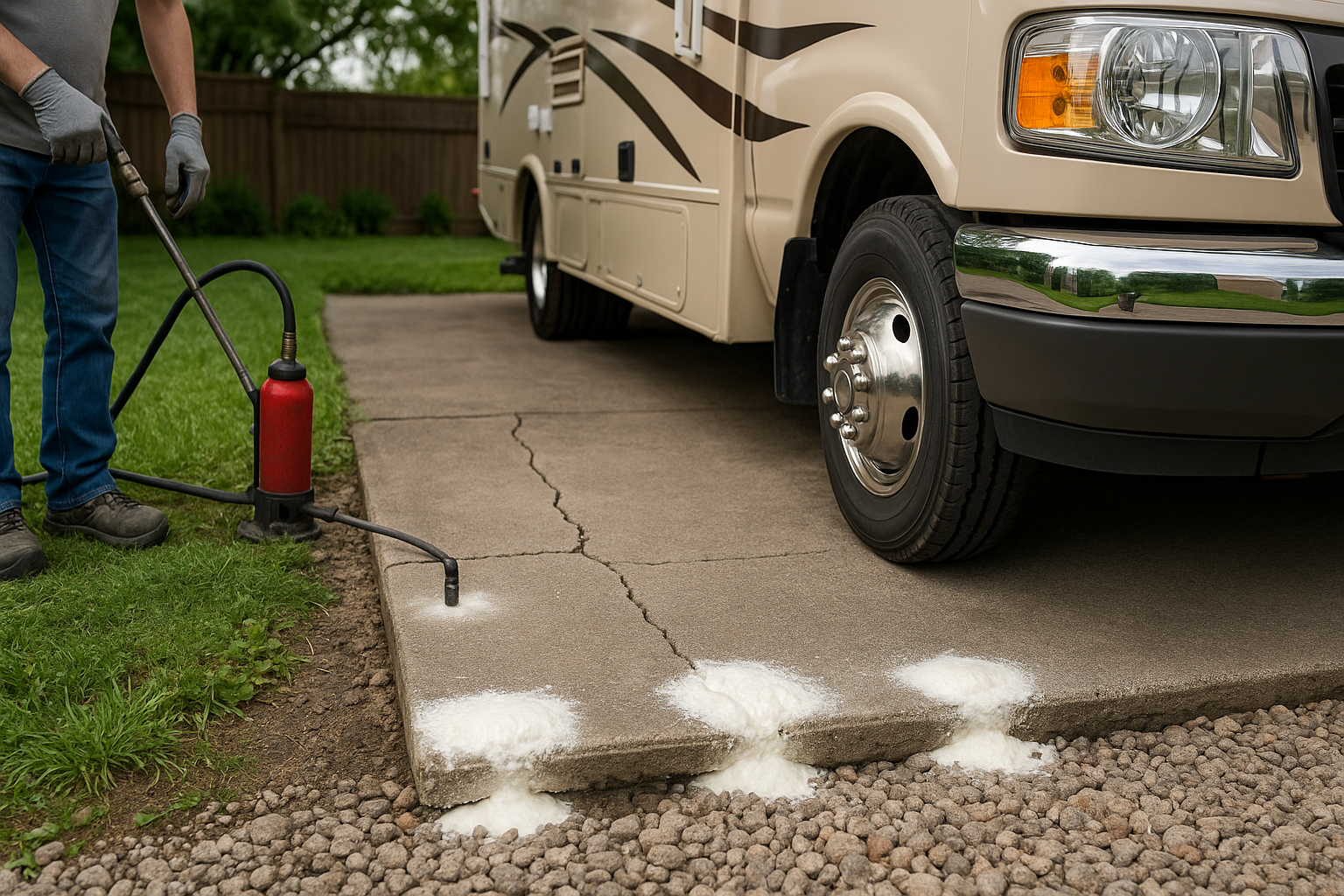
We drill a few small, strategically placed holes right through the sunken concrete. Then, we pump a specialized, highly durable slurry mixture under immense pressure through those holes. This dense material flows into the hidden voids, fills up the empty space completely, and gently pushes the heavy slab right back up to its original height.
It feels almost like magic watching a massive sheet of concrete just gracefully float back into place. But it’s really just solid, reliable engineering.
Why Not Just Pour Cement on Top?
Some people ask us why they can’t just buy a few bags of self-leveling cement and pour it over the low spots. Honestly, pouring new concrete on top of a sinking slab is like putting a tiny bandage on a broken arm. It adds significantly more weight to a foundation that is already actively failing.
The soil underneath is the actual culprit. If you do not fix the compromised base, the whole heavy mess is just going to keep sinking deeper into the dirt. You have to address the root cause, not just hide the symptoms.
Why Your RV Hates a Crooked Pad
Let’s take a quick detour and talk about your actual RV for a minute. We focus so heavily on the concrete that we often forget about the highly engineered, expensive piece of machinery sitting right on top of it.
If your motorhome, travel trailer, or fifth-wheel sits on an uneven surface for months at a time, bad things start to happen. You might assume the suspension can handle it. “It has heavy-duty springs and shocks, it’ll be fine.” I used to think the exact same thing! But keeping a rig parked at a permanent angle puts totally uneven, constant stress on the tires, axles, and delicate suspension components.
Over time, that uneven weight distribution can slowly warp the steel frame or cause permanent flat spots on your tires. Imagine dropping tens of thousands of dollars on a beautiful travel trailer just to slowly ruin the chassis because your driveway has a two-inch slope. It just does not make sense to neglect the parking surface.
Plus, you have to consider your RV’s onboard appliances. Propane refrigerators, for instance, need to be perfectly level to function safely and efficiently. If your rig is severely tilted while you are packing up and pre-cooling the fridge for a weekend trip to Bear Lake, you could literally destroy the cooling unit. Keeping your RV pad stable and level isn’t just about making your side yard look nice. It is entirely about protecting your massive recreational investment.
Can You Fix a Sinking Pad Yourself? (Spoiler: Probably Not)
I love a good DIY project. Building a backyard firepit? Go for it. Painting the living room or swapping out a faucet? Absolutely. But pumping pressurized grout under a 10,000-pound sheet of concrete? Yeah, you should probably leave that strictly to the professionals.
You can easily go down an internet rabbit hole watching videos of guys trying to lift their own concrete with expanding polyurethane foam kits they bought online. Sometimes it works okay for a tiny, lightweight sidewalk square. But a massive RV pad? That is a completely different beast altogether. The sheer volume of material needed to lift a slab that large and dense is massive.
If you do not know exactly what you are doing, you can easily over-lift the slab, causing it to crack aggressively right down the middle. Or worse, you completely miss the main underground void, the foam cures permanently, and you are stuck with a lopsided, glued-down mess that cannot be adjusted.
Professional Concrete Leveling services have the specialized equipment required to monitor the lifting pressure precisely to the millimeter. We know exactly where to drill the injection holes to get maximum lift without stressing the aged slab. It is quick, it is clean, and most importantly, it gets done right the very first time.
The Hidden Perks of a Leveled Slab
You fix the pad, your RV sits perfectly straight, and life is good. But there are a few other fantastic perks to getting this sorted out before the next harsh Utah winter hits our area.
First off, you immediately eliminate dangerous trip hazards. Nobody wants to twist an ankle or drop their gear while they are carrying a heavy cooler out to the camper in the dark.
Secondly, you fully restore proper water drainage. When concrete sinks, it frequently tilts backward toward your house or detached garage, sending heavy rain and melting snow directly into your foundation. By simply lifting the slab back to its original engineered grade, you ensure that water flows exactly where it is supposed to go—away from your valuable property.
Finally, addressing the problem now saves you serious money down the road. Tearing out an old, ruined RV pad and pouring a brand new one takes days, destroys your landscaping with heavy machinery, and costs a small fortune. Concrete lifting is usually fully completed in just a few short hours. You can literally back your truck up and park your rig right back on it the exact same afternoon.
Let’s Get That Pad Sorted Out
We live in a truly beautiful part of the state, and getting out to explore it is arguably the best part of owning an RV. Don’t let a sinking, cracking piece of concrete add unnecessary stress to your travels or slowly damage your rig while it sits safely at home. Getting things leveled out is so much easier than you might think, and the long-term peace of mind is worth every single penny.
If your RV pad is looking a little worse for wear, give Mud Dog Jacking a call today at 801-644-9122 to discuss your concrete leveling needs. We’re ready to help you protect your investment, so go ahead and Request a Free Quote to get your property back in top shape!