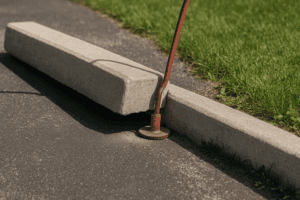

There is nothing quite as frustrating as tripping over that one uneven slab in your walkway while carrying groceries, or watching your expensive car bump awkwardly into the garage because the apron has sunk two inches. It’s unsightly, it’s a liability, and let’s be honest, it’s just one more thing on the never-ending list of home maintenance tasks that keeps you up at night. But before you panic and assume you need to rip everything out and start over, you should know that Concrete Lifting is usually the faster, smarter answer.
So, Why Does Concrete Sink in the First Place?
You might look at your Driveway and wonder how something that heavy and solid can just… move. It feels counterintuitive. But here in Ogden, we deal with some specific geological and weather patterns that make this incredibly common. It’s rarely the fault of the concrete itself; it’s almost always about the soil underneath it.
Here’s the thing about the soil along the Wasatch Front: it’s moody. We have cycles of freezing and thawing that can wreak havoc on the ground. When water gets under your slab and freezes, it expands, pushing the concrete up (heaving). When it melts, it leaves a void—an empty space where dirt used to be. Over time, gravity wins, and the slab settles into that empty space.
There are also issues with:
- Poor Compaction: Sometimes, when a house is built, the dirt wasn’t packed down tight enough before the driveway was poured.
- Erosion: A misplaced downspout can wash away soil over the years.
- Critters: Believe it or not, ants and rodents tunneling under a slab can actually displace enough dirt to cause issues.
You know what? It’s basically like putting a heavy book on top of a sponge. If the sponge (the soil) shrinks or washes away, the book (the concrete) is going to tilt.
The Terminology: Mudjacking vs. Polyjacking
If you start Googling around, you’re going to hear a lot of terms thrown at you. Slab jacking, mudjacking, poly lifting, Concrete Leveling. It can get a little confusing.
For decades, the standard way to fix this was “mudjacking.” This is the old-school method where a mixture of sand, water, and cement—basically a slurry or “mud”—is pumped under high pressure beneath the concrete. It fills the voids and hydraulically lifts the slab back up. It works, and it’s been done since the early 1900s.
But then technology came along.
Now, we often see polyurethane foam lifting (often called polyjacking). Instead of a heavy mud slurry, we use a high-density expanding foam. It’s fascinating stuff. Two liquids mix together at the injection point, react, and expand like crazy, filling every nook and cranny below the concrete. It creates a rigid, structural foam that is incredibly strong but lightweight.
A Quick Comparison
To help you visualize the difference, here is a breakdown of how these two methods stack up against each other.
| Feature | Mudjacking (Traditional) | Polyjacking (Modern Foam) |
|---|---|---|
| Hole Size | Larger (1-2 inches, soda can size) | Tiny (5/8 inch, dime size) |
| Weight | Heavy (adds weight to soil) | Lightweight (doesn’t burden soil) |
| Cure Time | 24 – 48 hours | 15 – 30 minutes |
| Longevity | Susceptible to erosion | Waterproof & permanent |
| Cost | Typically cheaper upfront | Slightly higher investment |
Why Not Just Rip It Out and Repost?
This is the question we hear most often. A homeowner looks at a cracked, sunken Sidewalk and thinks, “I should just hire a crew to smash this up and pour a fresh one.”
Honestly? You could do that. But it’s usually overkill.
Replacement is expensive. You are paying for the demolition crew, the disposal fees for the old concrete (which is heavy and costly to haul away), the new base material, the new concrete, and the labor to finish it. It adds up fast. Concrete lifting generally costs about 50% to 70% less than replacement. That is money you could use for literally anything else—a vacation, a new TV, or just savings.
Then there is the mess. Jackhammers are loud. Dust gets everywhere—on your siding, on your cars, in your windows. Plus, pouring new concrete means your driveway is a construction zone for days, sometimes weeks, while it cures. You can’t drive on fresh concrete immediately.
With lifting, specifically using poly, you can often drive your car over the slab 30 minutes after we finish. It’s barely an interruption to your Tuesday.
When Is Concrete Lifting Not the Answer?
I want to be transparent here because not every slab can be saved. There are times when replacement really is the only option.
If the concrete has crumbled into rubble—like, it looks more like a jigsaw puzzle than a sidewalk—lifting won’t help. There needs to be enough structural integrity in the slab to actually be lifted without snapping into smaller pieces.
Also, if the concrete is too thin (we usually like to see at least 3-4 inches of thickness), it might just crack when the pressure is applied.
But for the vast majority of sunken aprons, Steps, patios, and pool decks in Ogden, lifting is the way to go. If you have a clean crack and one side is lower than the other, that is the textbook scenario for a lift.
The Process: What Actually Happens?
So, let’s say you decide to go ahead with this. What does the day look like? It’s surprisingly low-key.
- The Drill: We drill small holes strategically through the sunken slab. If we are using poly, these holes are tiny—about the size of a penny. You won’t even notice them once we patch them.
- The Injection: We insert a port into the hole and hook up the hose. The material is pumped down into the void.
- The Lift: This is the cool part. As the material fills the space, pressure builds up. Eventually, the only place for the slab to go is up. We control the lift carefully, raising it incrementally until it’s level with the surrounding concrete.
- The Patch: We pull the ports, mix a little concrete patch material that matches your slab as closely as possible, and fill the holes.
And that’s it. No dumpsters, no caution tape blocking the driveway for a week.
Does It Last?
This is a fair question. If the soil settled once, won’t it settle again?
With mudjacking, there is a slight risk that the new slurry could erode over time if you don’t fix the underlying water drainage issue. Mud is heavy, too, so if the soil is super soft, the weight of the repair could technically cause more settling, though it’s rare if done right.
Polyurethane foam, however, is pretty much forever. It is hydrophobic, meaning it doesn’t rot or break down when it gets wet. In fact, it often helps stabilize the soil by displacing water and binding loose dirt together. Unless the ground underneath undergoes some massive geological shift or a sinkhole opens up (which, knock on wood, isn’t likely), that foam isn’t going anywhere.
Speaking of water—this is a good time for a quick digression. Check your gutters. Seriously. Most concrete settling issues in Ogden are caused by downspouts dumping water right next to the foundation or driveway. If you get your concrete lifted but don’t fix the drainage that caused the erosion, you’re just fighting a losing battle. Extension pipes are cheap; get them!
Is This a DIY Project?
I know, I know. We live in the era of YouTube. You might see a video of a guy using canned spray foam to lift a sidewalk block.
Please, for the love of your property value, don’t try this.
The “Great Stuff” foam you buy at the hardware store is not the same as the high-density structural foam we use. It doesn’t have the compressive strength to hold up a slab of concrete that weighs thousands of pounds. Furthermore, lifting requires understanding hydraulic pressure. If you pump too much in one spot without letting it spread, you can snap your slab in half instantly. Then you really will be paying for a full replacement.
It requires specialized equipment to heat the foam, mix the ratios correctly, and control the flow. It looks easy when a pro does it, but that’s because they’ve done it a thousand times.
Cost Factors to Consider
Since we mentioned that lifting is cheaper than replacing, you’re probably wondering, “Okay, but how much is it?”
It’s hard to give a blind number because every job is different, but the price is usually determined by:
- The size of the void: We aren’t just pricing based on the square footage of the concrete; we have to guess how big the hole under the concrete is.
- The amount of material: If your driveway has dropped four inches, it’s going to take a lot more foam or mud than if it dropped one inch.
- Accessibility: Is it a front walkway, or is it a Patio in the backyard that we have to drag hoses around a fence to reach?
Generally, smaller jobs like a single sidewalk square might cost a few hundred bucks, while lifting a large double-car driveway or a sinking Garage Floor will obviously cost more. But again, compare that to the thousands and thousands of dollars for a rip-and-replace job, and the math starts looking pretty good.
Aesthetic vs. Safety
We often talk about “Curb appeal,” and sure, a level driveway looks crisp. It signals that you take care of your home. In a real estate market that fluctuates, those details matter if you’re thinking of selling.
But really, this is about safety.
Trip hazards are a genuine liability. If the mail carrier or a neighbor trips on your uneven walkway, you could be facing a lawsuit that costs way more than a simple Concrete Repair. In the winter, those uneven spots catch the blade of your snow shovel (which creates a jarring impact that hurts your wrists—if you know, you know) and they create pockets where ice forms and stays.
Leveling the concrete eliminates those pools where water gathers and turns into black ice. It’s a proactive step to keep your family and visitors safe.
Finding the Right Contractor
In Utah, there are plenty of guys with trucks. You want someone who specializes in this. Concrete lifting is as much an art as it is a science. You have to “read” the slab. You have to know where to drill the holes to get the best lift without cracking the stone.
Look for a company that explains the process to you. They should be willing to walk around the property, point out why the settling happened (like that pesky downspout we talked about), and offer a warranty on their work. If they won’t guarantee the lift, run the other way.
Wrapping It Up
At the end of the day—sorry, I try not to use that phrase, but it fits here—your home is your biggest investment. Watching parts of it sink into the ground is stressful. But the fix is usually cleaner, faster, and cheaper than you think. You don’t have to live with a tripping hazard or a garage floor that slopes the wrong way.
If you are seeing signs of sinking concrete around your home in Ogden, don’t wait until the cracks get worse or the slab snaps. Mud Dog Jacking has the experience and the equipment to set things straight.
Give us a call at 801-644-9122 to discuss your project, or simply go online to Request a Free Quote. Let’s get that concrete back on solid ground.